Advertisements
Advertisements
Question
Which of the following statement is true for a rhombus?
It has two pairs of equal sides.
Advertisements
Solution
True
RELATED QUESTIONS
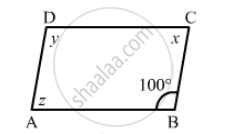
The following figure is parallelogram. Find the degree values of the unknowns x, y, z.
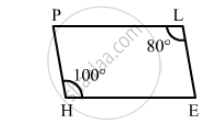
Can the following figure be parallelogram. Justify your answer.
Two adjacent sides of a parallelogram are 4 cm and 3 cm respectively. Find its perimeter.
In a parallelogram ABCD, AB = 10 cm, AD = 6 cm. The bisector of ∠A meets DC in E, AEand BC produced meet at F. Find te length CF.
Which of the following statement is true for a rhombus?
It is a parallelogram.
ABCD is a rhombus and its diagonals intersect at O.
(i) Is ∆BOC ≅ ∆DOC? State the congruence condition used?
(ii) Also state, if ∠BCO = ∠DCO.
If all pairs of adjacent sides of a quadrilateral are congruent then it is called ______.
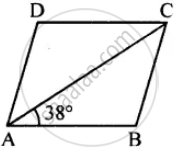
ABCD is a rhombus. If ∠BAC = 38°, find :
(i) ∠ACB
(ii) ∠DAC
(iii) ∠ADC.
If the diagonal of a rhombus are equal, then the rhombus is a
If a diagonal of a quadrilateral bisects both the angles, then it is a ______.
