Advertisements
Advertisements
Question
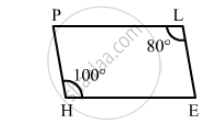
Can the following figure be parallelogram. Justify your answer.
Advertisements
Solution
\[\text{ No . This is because the opposite angles are not equal } . \]
RELATED QUESTIONS
Can the following figure be parallelogram. Justify your answer.
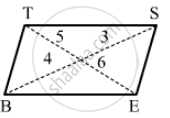
In the following figure GUNS and RUNS are parallelogram. Find x and y.
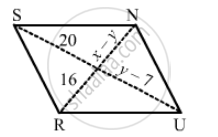
Two opposite angles of a parallelogram are (3x − 2)° and (50 − x)°. Find the measure of each angle of the parallelogram.
All the angles of a quadrilateral are equal to each other. Find the measure of each. Is the quadrilateral a parallelogram? What special type of parallelogram is it?
Points E and F lie on diagonal AC of a parallelogram ABCD such that AE = CF. What type of quadrilateral is BFDE?
Fill in the blank, inthe following, so as to make the statement true:
A rhombus has all its sides of ...... length.
ABCD is a rhombus and its diagonals intersect at O.
(i) Is ∆BOC ≅ ∆DOC? State the congruence condition used?
(ii) Also state, if ∠BCO = ∠DCO.
Diagonals PR and QS of a rhombus PQRS are 20 cm and 48 cm respectively. Find the length of side PQ.
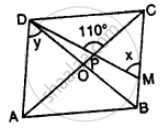
The given figure shows a rhombus ABCD in which angle BCD = 80°. Find angles x and y.
If all sides of a quadrilateral are equal, it is a ______.
