Advertisements
Advertisements
Question
Two opposite angles of a parallelogram are (3x − 2)° and (50 − x)°. Find the measure of each angle of the parallelogram.
Advertisements
Solution
\[\text{ Oppostie angles of a parallelogram are congurent } . \]
\[ \therefore \left( 3x - 2 \right)° = \left( 50 - x \right)°\]
\[3x°- 2° = 50°- x°\]
\[3x°+ x°= 50° + 2°\]
\[4x°= 52°\]
\[x° = 13°\]
\[\text{ Putting the value of x in one angle }: \]
\[3x° - 2°= 39°- 2°\]
\[ = 37°\]
\[\text{ Opposite angles are congurent }: \]
\[ \therefore 50 - x°\]
\[ = 37°\]
\[\text{ Let the remaining two angles be y and z } . \]
\[\text{ Angles y and z are congurent because they are also opposite angles } . \]
\[ \therefore y = z\]
\[\text{ The sum of adjacent angles of a paralle\logram is equal to } 180° . \]
\[ \therefore 37°+ y = 180°\]
\[y = 180°- 37°\]
\[y = 143°\]
\[\text{ So, the anlges measure are }: \]
\[37°, 37°, 143° \text{ and } 143°\]
RELATED QUESTIONS
The following figure is parallelogram. Find the degree values of the unknowns x, y, z.
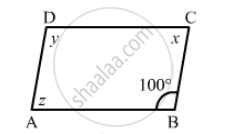
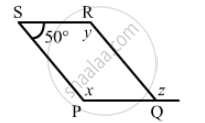
The following figure is parallelogram. Find the degree values of the unknown x, y, z.
Two adjacent sides of a parallelogram are 4 cm and 3 cm respectively. Find its perimeter.
In the following Figure ABCD is a arallelogram, CE bisects ∠C and AF bisects ∠A. In each of the following, if the statement is true, give a reason for the same:
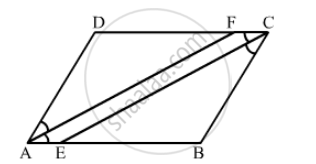
(i) ∠A = ∠C
(ii) \[\angle FAB = \frac{1}{2}\angle A\]
(iii) \[\angle DCE = \frac{1}{2}\angle C\]
(iv) \[\angle CEB = \angle FAB\]
(v) CE || AF
Fill in the blank, inthe following, so as to make the statement true:
A square is a rhombus in which .....
ABCD is a rhombus whose diagonals intersect at O. If AB = 10 cm, diagonal BD = 16 cm, find the length of diagonal AC.
Diagonals of a parallelogram intersect each other at point O. If AO = 5, BO = 12 and AB = 13 then show that `square`ABCD is a rhombus.
State with reason whether the following statement is ‘true’ or ‘false’.
Every parallelogram is a rhombus.
If opposite angles of a rhombus are (2x)° and (3x - 40)° then value of x is ______.
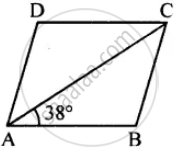
ABCD is a rhombus. If ∠BAC = 38°, find :
(i) ∠ACB
(ii) ∠DAC
(iii) ∠ADC.