Advertisements
Advertisements
Question
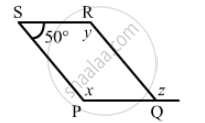
The following figure is parallelogram. Find the degree values of the unknown x, y, z.
Advertisements
Solution
\[\text{ Opposite angles of a parallelogram are same } . \]
\[ \therefore x = y \text{ and } \angle RQP = 100°\]
\[\angle PSR + \angle SRQ = 180°\]
\[y + 50°= 180°\]
\[x = 180°- 50°\]
\[x = 130°\]
\[ \therefore x = 130°, y = 130° \]
\[ \text{ Since y and z are alternate angles, z }= 130° . \]
RELATED QUESTIONS
If an angle of a parallelogram is two-third of its adjacent angle, find the angles of the parallelogram.
The measure of one angle of a parallelogram is 70°. What are the measures of the remaining angles?
Which of the following statement is true for a rhombus?
It has two pairs of parallel sides.
Fill in the blank, in the following, so as to make the statement true:
The diagonals of a rhombus ...... each other at ...... angles.
Draw a rhombus, having each side of length 3.5 cm and one of the angles as 40°.
The diagonals of a quadrilateral are of lengths 6 cm and 8 cm. If the diagonals bisect each other at right angles, what is the length of each side of the quadrilateral?
Diagonals of a parallelogram intersect each other at point O. If AO = 5, BO = 12 and AB = 13 then show that `square`ABCD is a rhombus.
Diagonals of a rhombus are 20 cm and 21 cm respectively, then find the side of rhombus and its perimeter.
If a diagonal of a quadrilateral bisects both the angles, then it is a ______.
In a rhombus diagonals intersect at ______ angles.
