Advertisements
Advertisements
प्रश्न
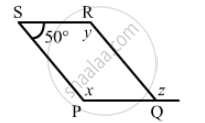
The following figure is parallelogram. Find the degree values of the unknown x, y, z.
Advertisements
उत्तर
\[\text{ Opposite angles of a parallelogram are same } . \]
\[ \therefore x = y \text{ and } \angle RQP = 100°\]
\[\angle PSR + \angle SRQ = 180°\]
\[y + 50°= 180°\]
\[x = 180°- 50°\]
\[x = 130°\]
\[ \therefore x = 130°, y = 130° \]
\[ \text{ Since y and z are alternate angles, z }= 130° . \]
संबंधित प्रश्न
Name the quadrilaterals whose diagonals are perpendicular bisectors of each other
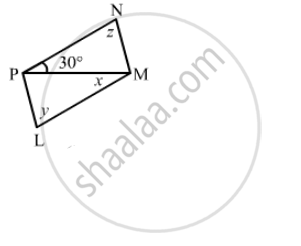
The following figure is parallelogram. Find the degree values of the unknown x, y, z.
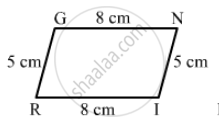
Can the following figure be parallelogram. Justify your answer.
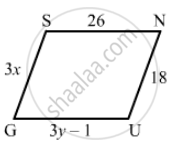
In the following figure GUNS and RUNS are parallelogram. Find x and y.
The measure of one angle of a parallelogram is 70°. What are the measures of the remaining angles?
Fill in the blank, in the following, so as to make the statement true:
The diagonals of a rhombus ...... each other at ...... angles.
ABCD is a rhombus. If ∠ACB = 40°, find ∠ADB.
One side of a rhombus is of length 4 cm and the length of an altitude is 3.2 cm. Draw the rhombus.
ABCD is a rhombus whose diagonals intersect at O. If AB = 10 cm, diagonal BD = 16 cm, find the length of diagonal AC.
State with reason whether the following statement is ‘true’ or ‘false’.
Every parallelogram is a rhombus.
