Advertisements
Advertisements
प्रश्न
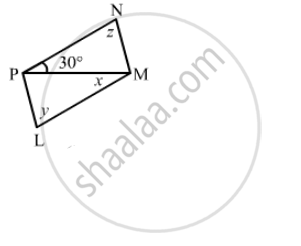
The following figure is parallelogram. Find the degree values of the unknown x, y, z.
Advertisements
उत्तर
\[\text{ Sum of all angles in a triangle is } {180}^° . \]
\[ \therefore 30° + 90° + z = 180°\]
\[z = 60°\]
\[\text{ Opposite angles are equal in parallelogram } . \]
\[ \therefore y = z = 60°\]
\[\text{ and } x = 30° (\text{ alternate angles })\]
संबंधित प्रश्न
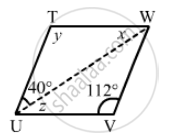
The following figure is parallelogram. Find the degree value of the unknown x, y, z.
Two adjacent angles of a parallelogram are as 1 : 2. Find the measures of all the angles of the parallelogram.
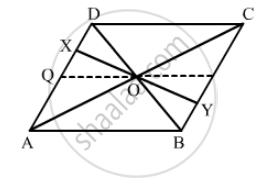
Diagonals of parallelogram ABCD intersect at O as shown in the following fegure. XY contains O, and X, Y are points on opposite sides of the parallelogram. Give reasons for each of the following:
(i) OB = OD
(ii) ∠OBY = ∠ODX
(iii) ∠BOY = ∠DOX
(iv) ∆BOY ≅ ∆DOX
Now, state if XY is bisected at O.
Which of the following statement is true for a rhombus?
It can be a square.
Fill in the blank, inthe following, so as to make the statement true:
A square is a rhombus in which .....
Fill in the blank, inthe following, so as to make the statement true:
A rhombus has all its sides of ...... length.
Which of the following statement is true for a rectangle?
Its diagonals are equal and bisect each other.
In a rhombus PQRS if PQ = 7.5 cm then find QR. If ∠QPS = 75° then find the measure of ∠PQR and ∠SRQ.
The lengths of the diagonals of a Rhombus are 12 cm and 16 cm. Find the side of the rhombus
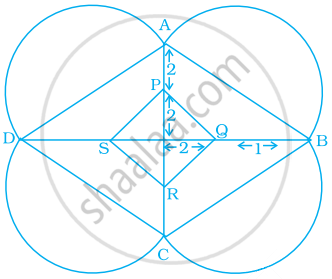
A Rangoli has been drawn on a flor of a house. ABCD and PQRS both are in the shape of a rhombus. Find the radius of semicircle drawn on each side of rhombus ABCD.