Advertisements
Advertisements
प्रश्न
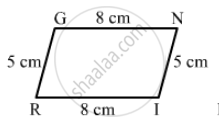
Can the following figure be parallelogram. Justify your answer.
Advertisements
उत्तर
\[\text{ Yes . This is because the opposite sides are equal } . \]
संबंधित प्रश्न
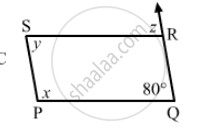
The following figure is parallelogram. Find the degree values of the unknown x, y, z.
The sum of two opposite angles of a parallelogram is 130°. Find all the angles of the parallelogram.
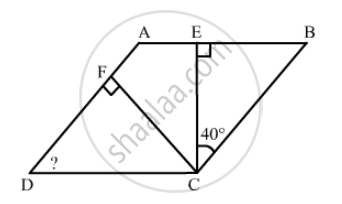
Find the angles marked with a question mark shown in Fig. 17.27
Which of the following statement is true for a rhombus?
It has two pairs of parallel sides.
Diagonals of a rhombus are 20 cm and 21 cm respectively, then find the side of rhombus and its perimeter.
If opposite angles of a rhombus are (2x)° and (3x - 40)° then value of x is ______.
Diagonals PR and QS of a rhombus PQRS are 20 cm and 48 cm respectively. Find the length of side PQ.
The lengths of the diagonals of a Rhombus are 12 cm and 16 cm. Find the side of the rhombus
If the diagonal of a rhombus are equal, then the rhombus is a
ABCD is a rhombus such that the perpendicular bisector of AB passes through D. Find the angles of the rhombus.
Hint: Join BD. Then ∆ABD is equilateral.
