Advertisements
Advertisements
प्रश्न
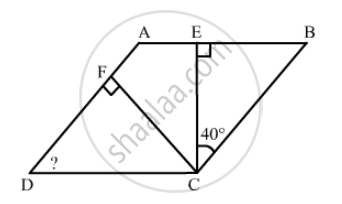
Find the angles marked with a question mark shown in Fig. 17.27
Advertisements
उत्तर
\[\text{ In } \bigtriangleup CEB: \]
\[\angle ECB + \angle CBE + \angle BEC = 180° (\text{ angle sum property of a triangle })\]
\[40° + 90° + \angle EBC = 180° \]
\[ \therefore \angle EBC = 50° \]
\[\text{ Also }, \angle EBC = \angle ADC = 50° \left( \text{ opposite angle of a parallelogram } \right)\]
\[\text{ In } \bigtriangleup FDC: \]
\[\angle FDC + \angle DCF + \angle CFD = 180° \]
\[50° + 90° + \angle DCF = 180° \]
\[ \therefore \angle DCF = 40° \]
\[\text{ Now }, \angle BCE + \angle ECF + \angle FCD + \angle FDC = 180° (\text{ in a parallelogram, the sum of alternate angles is } 180° )\]
\[50° + 40° + \angle ECF + 40° = 180° \]
\[\angle ECF = 180° - 50° + 40° - 40° = 50° \]
संबंधित प्रश्न
In the following Figure ABCD is a arallelogram, CE bisects ∠C and AF bisects ∠A. In each of the following, if the statement is true, give a reason for the same:
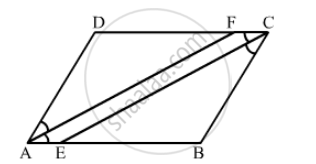
(i) ∠A = ∠C
(ii) \[\angle FAB = \frac{1}{2}\angle A\]
(iii) \[\angle DCE = \frac{1}{2}\angle C\]
(iv) \[\angle CEB = \angle FAB\]
(v) CE || AF
Which of the following statement is true for a rhombus?
It has two pairs of equal sides.
Which of the following statement is true for a rhombus?
It is a quadrilateral.
The diagonals of a parallelogram are not perpendicular. Is it a rhombus? Why or why not?
Construct a rhombus whose diagonals are of length 10 cm and 6 cm.
ABCD is a rhombus and its diagonals intersect at O.
(i) Is ∆BOC ≅ ∆DOC? State the congruence condition used?
(ii) Also state, if ∠BCO = ∠DCO.
Identify all the quadrilateral that have Four sides of equal length
Diagonals of a rhombus are 20 cm and 21 cm respectively, then find the side of rhombus and its perimeter.
If all sides of a quadrilateral are equal, it is a ______.
All rhombuses are squares.
