Advertisements
Advertisements
प्रश्न
In the following Figure ABCD is a arallelogram, CE bisects ∠C and AF bisects ∠A. In each of the following, if the statement is true, give a reason for the same:
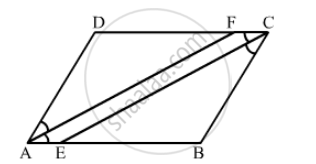
(i) ∠A = ∠C
(ii) \[\angle FAB = \frac{1}{2}\angle A\]
(iii) \[\angle DCE = \frac{1}{2}\angle C\]
(iv) \[\angle CEB = \angle FAB\]
(v) CE || AF
Advertisements
उत्तर
(i) True, since opposite angles of a parallelogram are equal.
(ii) True, as AF is the bisector of\[\angle\] A.
(iii) True, as CE is the bisector of \[\angle\]C.
(iv) True
\[\angle\]CEB =\[\angle\] DCE........(i) (alternate angles)
\[\angle\]DCE= \[\angle\] FAB.........(ii) (opposite angles of a parallelogram are equal)
From equations (i) and (ii):
\[\angle\] CEB =\[\angle\]FAB
(v) True, as corresponding angles are equal (\[\angle\] CEB =\[\angle\] FAB).
संबंधित प्रश्न
The following figure is parallelogram. Find the degree values of the unknowns x, y, z.
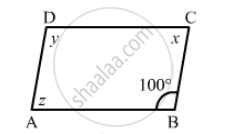
The following figure is parallelogram. Find the degree values of the unknown x, y, z.
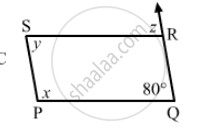
ABCD is a parallelogram in which ∠A = 70°. Compute ∠B, ∠C and ∠D.
Two adjacent sides of a parallelogram are 4 cm and 3 cm respectively. Find its perimeter.
Which of the following statement is true for a rhombus?
It is a square.
State with reason whether the following statement is ‘true’ or ‘false’.
Every parallelogram is a rhombus.
ABCD is a rhombus. If ∠BAC = 38°, find :
(i) ∠ACB
(ii) ∠DAC
(iii) ∠ADC.
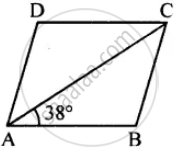
If the adjacent sides of a parallelogram are equal then parallelogram is a ______.
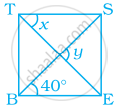
In the figure, BEST is a rhombus, Then the value of y – x is ______.
Diagonals of a quadrilateral are perpendicular to each other. Is such a quadrilateral always a rhombus? Give a figure to justify your answer.
