Advertisements
Advertisements
प्रश्न
In the following Figure ABCD is a arallelogram, CE bisects ∠C and AF bisects ∠A. In each of the following, if the statement is true, give a reason for the same:
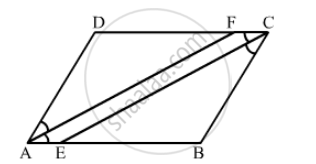
(i) ∠A = ∠C
(ii) \[\angle FAB = \frac{1}{2}\angle A\]
(iii) \[\angle DCE = \frac{1}{2}\angle C\]
(iv) \[\angle CEB = \angle FAB\]
(v) CE || AF
Advertisements
उत्तर
(i) True, since opposite angles of a parallelogram are equal.
(ii) True, as AF is the bisector of\[\angle\] A.
(iii) True, as CE is the bisector of \[\angle\]C.
(iv) True
\[\angle\]CEB =\[\angle\] DCE........(i) (alternate angles)
\[\angle\]DCE= \[\angle\] FAB.........(ii) (opposite angles of a parallelogram are equal)
From equations (i) and (ii):
\[\angle\] CEB =\[\angle\]FAB
(v) True, as corresponding angles are equal (\[\angle\] CEB =\[\angle\] FAB).
संबंधित प्रश्न
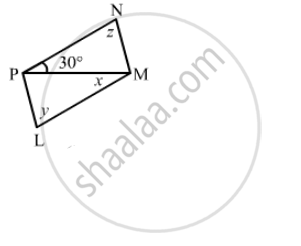
The following figure is parallelogram. Find the degree values of the unknown x, y, z.
In a parallelogram ABCD, AB = 10 cm, AD = 6 cm. The bisector of ∠A meets DC in E, AEand BC produced meet at F. Find te length CF.
Which of the following statement is true for a rhombus?
It has two pairs of equal sides.
Fill in the blank, in the following, so as to make the statement true:
A rhombus is a parallelogram in which ......
Fill in the blank, inthe following, so as to make the statement true:
A square is a rhombus in which .....
The diagonals of a parallelogram are not perpendicular. Is it a rhombus? Why or why not?
Draw a rhombus ABCD, if AB = 6 cm and AC = 5 cm.
ABCD is a rhombus whose diagonals intersect at O. If AB = 10 cm, diagonal BD = 16 cm, find the length of diagonal AC.
In a rhombus PQRS if PQ = 7.5 cm then find QR. If ∠QPS = 75° then find the measure of ∠PQR and ∠SRQ.
In a rhombus diagonals intersect at ______ angles.
