Advertisements
Advertisements
प्रश्न
ABCD is a rhombus. If ∠BCA = 35°. find ∠ADC.
Advertisements
उत्तर
Given : Rhombus ABCD in which ∠BCA = 35°
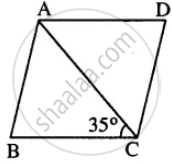
To find : ∠ADC
Proof : AD || BC
∠DAC = ∠BCA (Alternate ∠s)
But ∠BCA = 35° (Given)
∠DAC = 35°
But ∠DAC = ∠ACD ( AD = CD) & ∠DAC +∠ACD + ∠ADC = 180°
35°+ 35° + ∠ADC = 180°
∠ADC = 180° – 70° = 110°
Hence ∠ADC = 110°
APPEARS IN
संबंधित प्रश्न
Which of the following statement is true for a rhombus?
It has two pairs of parallel sides.
Which of the following statement is true for a rhombus?
It is a quadrilateral.
The diagonals of a quadrilateral are perpendicular to each other. Is such a quadrilateral always a rhombus? If your answer is 'No', draw a figure to justify your answer.
ABCD is a rhombus and its diagonals intersect at O.
(i) Is ∆BOC ≅ ∆DOC? State the congruence condition used?
(ii) Also state, if ∠BCO = ∠DCO.
ABCD is a rhombus whose diagonals intersect at O. If AB = 10 cm, diagonal BD = 16 cm, find the length of diagonal AC.
Identify all the quadrilateral that have Four sides of equal length
If all pairs of adjacent sides of a quadrilateral are congruent then it is called ______.
In rhombus ABCD;
(i) if ∠A = 74° ; find ∠B and ∠C.
(ii) if AD = 7.5 cm ; find BC and CD.
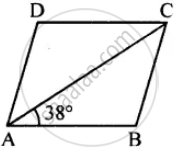
ABCD is a rhombus. If ∠BAC = 38°, find :
(i) ∠ACB
(ii) ∠DAC
(iii) ∠ADC.
If a diagonal of a quadrilateral bisects both the angles, then it is a ______.
