Advertisements
Advertisements
Question
ABCD is a rhombus. If ∠BCA = 35°. find ∠ADC.
Advertisements
Solution
Given : Rhombus ABCD in which ∠BCA = 35°
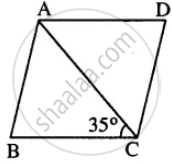
To find : ∠ADC
Proof : AD || BC
∠DAC = ∠BCA (Alternate ∠s)
But ∠BCA = 35° (Given)
∠DAC = 35°
But ∠DAC = ∠ACD ( AD = CD) & ∠DAC +∠ACD + ∠ADC = 180°
35°+ 35° + ∠ADC = 180°
∠ADC = 180° – 70° = 110°
Hence ∠ADC = 110°
APPEARS IN
RELATED QUESTIONS
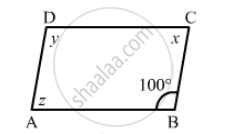
The following figure is parallelogram. Find the degree values of the unknowns x, y, z.
In a parallelogram ABCD, AB = 10 cm, AD = 6 cm. The bisector of ∠A meets DC in E, AEand BC produced meet at F. Find te length CF.
Which of the following statement is true for a rhombus?
It is a quadrilateral.
Fill in the blank, inthe following, so as to make the statement true:
A square is a rhombus in which .....
If the diagonals of a rhombus are 12 cm and 16cm, find the length of each side.
Draw a rhombus ABCD, if AB = 6 cm and AC = 5 cm.
Which of the following statement is true for a rectangle?
Its diagonals are equal and bisect each other.
In rhombus ABCD;
(i) if ∠A = 74° ; find ∠B and ∠C.
(ii) if AD = 7.5 cm ; find BC and CD.
A quadrilateral whose all sides are equal, opposite angles are equal and the diagonals bisect each other at right angles is a ______.
A rhombus is a parallelogram in which ______ sides are equal.
