Advertisements
Advertisements
Question
If the diagonals of a rhombus are 12 cm and 16cm, find the length of each side.
Advertisements
Solution
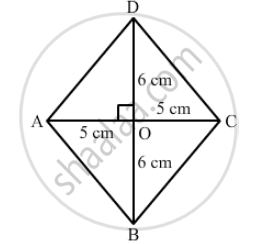
\[\text{ All sides of a rhombus are equal in length }. \]
\[\text{ The diagonals intersect at 90\textdegree and the sides of the rhombus form right triangles } . \]
\[\text{ One leg of these right triangles is equal to 8 cm and the other is equal to 6 cm } . \]
\[\text{ The sides of the triangle form the hypotenuse of these right triangles }. \]
\[\text{ So, we get }: \]
\[( 8^2 + 6^2 ) {cm}^2 \]
\[ = (64 + 36) {cm}^2 \]
\[ = 100 {cm}^2 \]
\[\text{ The hypotneuse is the square root of 100 {cm}^2 . This makes the hypotneuse equal to 10 }. \]
\[\text{ Thus, the side of the rhombus is equal to 10 cm } .\]
RELATED QUESTIONS
All rhombuses are parallelograms.
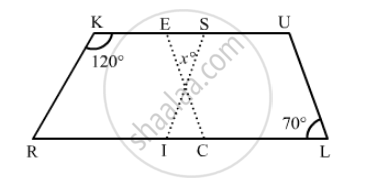
In the following figure RISK and CLUE are parallelograms. Find the measure of x.
Which of the following statement is true for a rhombus?
It is a parallelogram.
Which of the following statement is true for a rhombus?
It is a quadrilateral.
Fill in the blank, in each of the following, so as to make the statement true:
If the diagonals of a parallelogram bisect each other at right angles, then it is a ......
Diagonals of a parallelogram intersect each other at point O. If AO = 5, BO = 12 and AB = 13 then show that `square`ABCD is a rhombus.
Diagonals PR and QS of a rhombus PQRS are 20 cm and 48 cm respectively. Find the length of side PQ.
Lengths of diagonals of a rhombus ABCD are 16 cm and 12 cm. Find the side and perimeter of the rhombus.
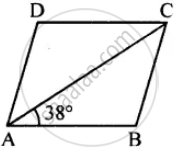
ABCD is a rhombus. If ∠BAC = 38°, find :
(i) ∠ACB
(ii) ∠DAC
(iii) ∠ADC.
ABCD is a rhombus. If ∠BCA = 35°. find ∠ADC.
