Advertisements
Advertisements
प्रश्न
If the diagonals of a rhombus are 12 cm and 16cm, find the length of each side.
Advertisements
उत्तर
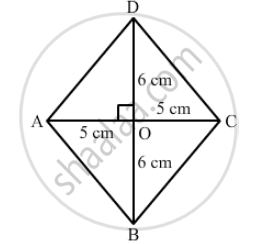
\[\text{ All sides of a rhombus are equal in length }. \]
\[\text{ The diagonals intersect at 90\textdegree and the sides of the rhombus form right triangles } . \]
\[\text{ One leg of these right triangles is equal to 8 cm and the other is equal to 6 cm } . \]
\[\text{ The sides of the triangle form the hypotenuse of these right triangles }. \]
\[\text{ So, we get }: \]
\[( 8^2 + 6^2 ) {cm}^2 \]
\[ = (64 + 36) {cm}^2 \]
\[ = 100 {cm}^2 \]
\[\text{ The hypotneuse is the square root of 100 {cm}^2 . This makes the hypotneuse equal to 10 }. \]
\[\text{ Thus, the side of the rhombus is equal to 10 cm } .\]
संबंधित प्रश्न
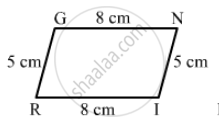
Can the following figure be parallelogram. Justify your answer.
In a parallelogram ABCD, ∠D = 135°, determine the measure of ∠A and ∠B.
The sum of two opposite angles of a parallelogram is 130°. Find all the angles of the parallelogram.
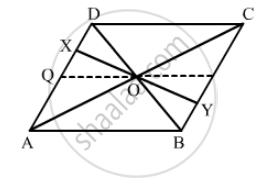
Diagonals of parallelogram ABCD intersect at O as shown in the following fegure. XY contains O, and X, Y are points on opposite sides of the parallelogram. Give reasons for each of the following:
(i) OB = OD
(ii) ∠OBY = ∠ODX
(iii) ∠BOY = ∠DOX
(iv) ∆BOY ≅ ∆DOX
Now, state if XY is bisected at O.
In the following Figure ABCD is a arallelogram, CE bisects ∠C and AF bisects ∠A. In each of the following, if the statement is true, give a reason for the same:
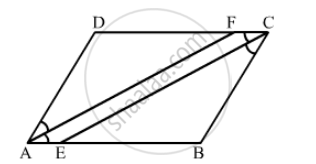
(i) ∠A = ∠C
(ii) \[\angle FAB = \frac{1}{2}\angle A\]
(iii) \[\angle DCE = \frac{1}{2}\angle C\]
(iv) \[\angle CEB = \angle FAB\]
(v) CE || AF
Which of the following statement is true for a rhombus?
Its diagonals are equal and perpendicular.
The diagonals of a parallelogram are not perpendicular. Is it a rhombus? Why or why not?
Draw a rhombus KLMN such that its side is 4 cm and m∠K = 75°.
If a diagonal of a quadrilateral bisects both the angles, then it is a ______.
If all sides of a quadrilateral are equal, it is a ______.
