Advertisements
Advertisements
प्रश्न
In a parallelogram ABCD, ∠D = 135°, determine the measure of ∠A and ∠B.
Advertisements
उत्तर
\[\text{ In a parallelogram, opposite angles have the same value }. \]
\[ \therefore \angle D = \angle B\]
\[ = 135°\]
\[\text{ Also }, \angle A + \angle B + \angle C + \angle D = 360°\]
\[\angle A + \angle D = 180° \left( \text{ Popposite angles have the same value }\right)\]
\[\angle A = 180°- 135° = 45°\]
\[\angle A = 45°\]
संबंधित प्रश्न
All rhombuses are parallelograms.
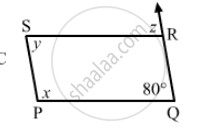
The following figure is parallelogram. Find the degree values of the unknown x, y, z.
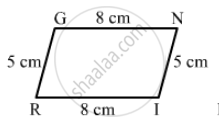
Can the following figure be parallelogram. Justify your answer.
Two opposite angles of a parallelogram are (3x − 2)° and (50 − x)°. Find the measure of each angle of the parallelogram.
Which of the following statement is true for a rhombus?
Its diagonals bisect each other at right angles.
Which of the following statement is true for a rhombus?
Its diagonals are equal and perpendicular.
Fill in the blank, inthe following, so as to make the statement true:
A square is a rhombus in which .....
In a rhombus PQRS if PQ = 7.5 cm then find QR. If ∠QPS = 75° then find the measure of ∠PQR and ∠SRQ.
If opposite angles of a rhombus are (2x)° and (3x - 40)° then value of x is ______.
In a rhombus diagonals intersect at ______ angles.
