Advertisements
Advertisements
प्रश्न
In a parallelogram ABCD, ∠D = 135°, determine the measure of ∠A and ∠B.
Advertisements
उत्तर
\[\text{ In a parallelogram, opposite angles have the same value }. \]
\[ \therefore \angle D = \angle B\]
\[ = 135°\]
\[\text{ Also }, \angle A + \angle B + \angle C + \angle D = 360°\]
\[\angle A + \angle D = 180° \left( \text{ Popposite angles have the same value }\right)\]
\[\angle A = 180°- 135° = 45°\]
\[\angle A = 45°\]
संबंधित प्रश्न
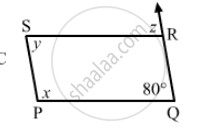
The following figure is parallelogram. Find the degree values of the unknown x, y, z.
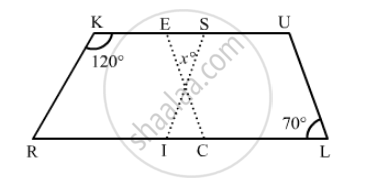
In the following figure RISK and CLUE are parallelograms. Find the measure of x.
Points E and F lie on diagonal AC of a parallelogram ABCD such that AE = CF. What type of quadrilateral is BFDE?
Which of the following statement is true for a rhombus?
It can be a square.
Fill in the blank, inthe following, so as to make the statement true:
A square is a rhombus in which .....
The diagonals of a parallelogram are not perpendicular. Is it a rhombus? Why or why not?
State with reason whether the following statement is ‘true’ or ‘false’.
Every parallelogram is a rhombus.
State with reason whether the following statement is ‘true’ or ‘false’.
Every rhombus is a rectangle.
Lengths of diagonals of a rhombus ABCD are 16 cm and 12 cm. Find the side and perimeter of the rhombus.
All rhombuses are squares.
