Advertisements
Advertisements
Question
In a parallelogram ABCD, ∠D = 135°, determine the measure of ∠A and ∠B.
Advertisements
Solution
\[\text{ In a parallelogram, opposite angles have the same value }. \]
\[ \therefore \angle D = \angle B\]
\[ = 135°\]
\[\text{ Also }, \angle A + \angle B + \angle C + \angle D = 360°\]
\[\angle A + \angle D = 180° \left( \text{ Popposite angles have the same value }\right)\]
\[\angle A = 180°- 135° = 45°\]
\[\angle A = 45°\]
RELATED QUESTIONS
The following figure is parallelogram. Find the degree values of the unknown x, y, z.
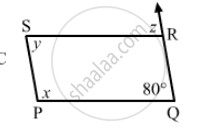
The following figure is parallelogram. Find the degree value of the unknown x, y, z.
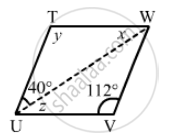
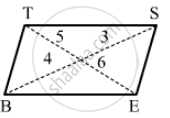
Can the following figure be parallelogram. Justify your answer.
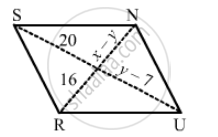
In the following figure GUNS and RUNS are parallelogram. Find x and y.
Two adjacent angles of a parallelogram are as 1 : 2. Find the measures of all the angles of the parallelogram.
The sum of two opposite angles of a parallelogram is 130°. Find all the angles of the parallelogram.
Fill in the blank, in the following, so as to make the statement true:
A rhombus is a parallelogram in which ......
The diagonals of a parallelogram are not perpendicular. Is it a rhombus? Why or why not?
If the diagonals of a rhombus are 12 cm and 16cm, find the length of each side.
Identify all the quadrilateral that have Four sides of equal length
