Advertisements
Advertisements
Question
All rhombuses are parallelograms.
Options
True
False
Advertisements
Solution
This statement is True.
Explanation:
Yes, because both diagonals bisect each other and opposite sides are equal.
RELATED QUESTIONS
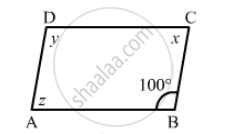
The following figure is parallelogram. Find the degree values of the unknowns x, y, z.
Two adjacent sides of a parallelogram are 4 cm and 3 cm respectively. Find its perimeter.
In the following Figure ABCD is a arallelogram, CE bisects ∠C and AF bisects ∠A. In each of the following, if the statement is true, give a reason for the same:
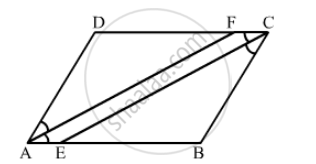
(i) ∠A = ∠C
(ii) \[\angle FAB = \frac{1}{2}\angle A\]
(iii) \[\angle DCE = \frac{1}{2}\angle C\]
(iv) \[\angle CEB = \angle FAB\]
(v) CE || AF
Which of the following statement is true for a rhombus?
It can be a square.
Fill in the blank, in the following, so as to make the statement true:
The diagonals of a rhombus ...... each other at ...... angles.
In a rhombus PQRS if PQ = 7.5 cm then find QR. If ∠QPS = 75° then find the measure of ∠PQR and ∠SRQ.
Diagonals of a rhombus are 20 cm and 21 cm respectively, then find the side of rhombus and its perimeter.
State with reason whether the following statement is ‘true’ or ‘false’.
Every parallelogram is a rhombus.
The lengths of the diagonals of a Rhombus are 12 cm and 16 cm. Find the side of the rhombus
Construct a rhombus CLUE in which CL = 7.5 cm and LE = 6 cm.
