Advertisements
Advertisements
Question
Diagonals of a rhombus are 20 cm and 21 cm respectively, then find the side of rhombus and its perimeter.
Advertisements
Solution
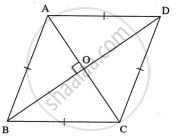
Let `square`ABCD be the rhombus.
AC = 20 cm, BD = 21 cm
AO = `1/2` AC ...[Diagonals of a rhombus bisect each other]
= `1/2 xx 20`
= 10 cm ...(i)
BO = `1/2` BD ...[Diagonals of a rhombus bisect each other]
= `1/2 xx21`
= `21/2`
= 10.5 cm ...(ii)
In ∆AOB,
∠AOB = 90° ...[Diagonals of a rhombus are perpendicular to each other]
By Pythagoras theorem,
∴ AB2 = AO2 + BO2
∴ AB2 = 102 + 10.52
∴ AB2 = 100 + 110.25
∴ AB2 = 210.25
∴ AB = `sqrt(210.25)`
∴ AB = 14.5 cm
Perimeter of `square`ABCD = 4 × AB
= 4 × 14.5
= 58 cm
APPEARS IN
RELATED QUESTIONS
The following figure is parallelogram. Find the degree values of the unknown x, y, z.
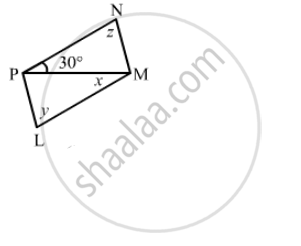
The following figure is parallelogram. Find the degree values of the unknown x, y, z.
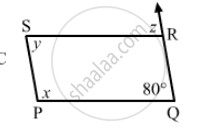
Can the following figure be parallelogram. Justify your answer.
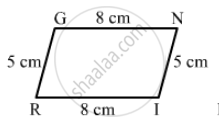
Can the following figure be parallelogram. Justify your answer.
Find the angles marked with a question mark shown in Fig. 17.27
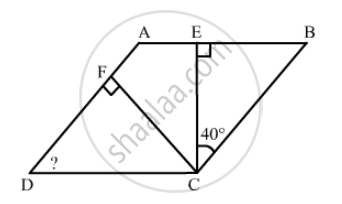
Which of the following statement is true for a rhombus?
It can be a square.
Fill in the blank, inthe following, so as to make the statement true:
A square is a rhombus in which .....
Fill in the blank, in each of the following, so as to make the statement true:
If the diagonals of a parallelogram bisect each other at right angles, then it is a ......
The diagonals of a quadrilateral are perpendicular to each other. Is such a quadrilateral always a rhombus? If your answer is 'No', draw a figure to justify your answer.
ABCD is a rhombus and its diagonals intersect at O.
(i) Is ∆BOC ≅ ∆DOC? State the congruence condition used?
(ii) Also state, if ∠BCO = ∠DCO.
Diagonals of a parallelogram intersect each other at point O. If AO = 5, BO = 12 and AB = 13 then show that `square`ABCD is a rhombus.
If all pairs of adjacent sides of a quadrilateral are congruent then it is called ______.
The given figure shows a rhombus ABCD in which angle BCD = 80°. Find angles x and y.
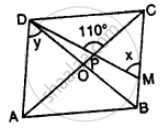
The lengths of the diagonals of a Rhombus are 12 cm and 16 cm. Find the side of the rhombus
If the diagonal of a rhombus are equal, then the rhombus is a
A quadrilateral whose all sides are equal, opposite angles are equal and the diagonals bisect each other at right angles is a ______.
If the adjacent sides of a parallelogram are equal then parallelogram is a ______.
Diagonals of a quadrilateral are perpendicular to each other. Is such a quadrilateral always a rhombus? Give a figure to justify your answer.
Construct a rhombus CLUE in which CL = 7.5 cm and LE = 6 cm.
