Advertisements
Advertisements
Question
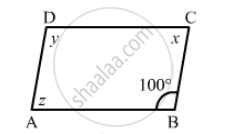
The following figure is parallelogram. Find the degree values of the unknowns x, y, z.
Advertisements
Solution
\[\text{ Opposite angles of a parallelogram are same } . \]
\[ \therefore x = z \text{ and } y = 100°\]
\[\text{ Also }, y + z = 180° (\text{ sum of adjacent angles of a quadrilateral is } 180°)\]
\[z + 100°= 180°\]
\[x = 180° - 100°\]
\[x = 80°\]
\[ \therefore x = 80°e, y = 100° \text{ and } z = 80°\]
RELATED QUESTIONS
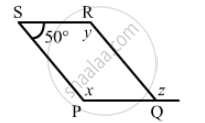
The following figure is parallelogram. Find the degree values of the unknown x, y, z.
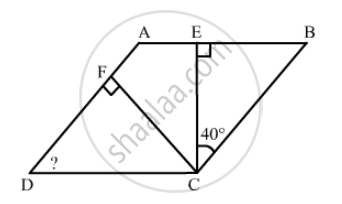
Find the angles marked with a question mark shown in Fig. 17.27
Points E and F lie on diagonal AC of a parallelogram ABCD such that AE = CF. What type of quadrilateral is BFDE?
Fill in the blank, inthe following, so as to make the statement true:
A square is a rhombus in which .....
One side of a rhombus is of length 4 cm and the length of an altitude is 3.2 cm. Draw the rhombus.
Draw a rhombus ABCD, if AB = 6 cm and AC = 5 cm.
Diagonals of a parallelogram intersect each other at point O. If AO = 5, BO = 12 and AB = 13 then show that `square`ABCD is a rhombus.
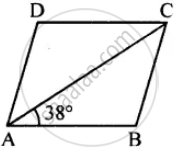
ABCD is a rhombus. If ∠BAC = 38°, find :
(i) ∠ACB
(ii) ∠DAC
(iii) ∠ADC.
If a diagonal of a quadrilateral bisects both the angles, then it is a ______.
Construct a rhombus CLUE in which CL = 7.5 cm and LE = 6 cm.
