Advertisements
Advertisements
प्रश्न
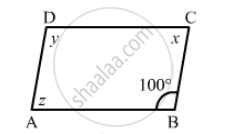
The following figure is parallelogram. Find the degree values of the unknowns x, y, z.
Advertisements
उत्तर
\[\text{ Opposite angles of a parallelogram are same } . \]
\[ \therefore x = z \text{ and } y = 100°\]
\[\text{ Also }, y + z = 180° (\text{ sum of adjacent angles of a quadrilateral is } 180°)\]
\[z + 100°= 180°\]
\[x = 180° - 100°\]
\[x = 80°\]
\[ \therefore x = 80°e, y = 100° \text{ and } z = 80°\]
संबंधित प्रश्न
Can the following figure be parallelogram. Justify your answer.
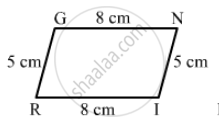
Can the following figure be parallelogram. Justify your answer.
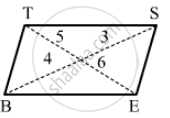
In the following figure GUNS and RUNS are parallelogram. Find x and y.
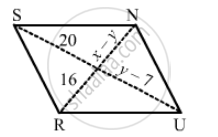
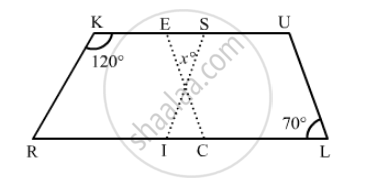
In the following figure RISK and CLUE are parallelograms. Find the measure of x.
Two opposite angles of a parallelogram are (3x − 2)° and (50 − x)°. Find the measure of each angle of the parallelogram.
ABCD is a parallelogram in which ∠A = 70°. Compute ∠B, ∠C and ∠D.
Which of the following statement is true for a rhombus?
It is a square.
One side of a rhombus is of length 4 cm and the length of an altitude is 3.2 cm. Draw the rhombus.
State with reason whether the following statement is ‘true’ or ‘false’.
Every parallelogram is a rhombus.
Construct a rhombus CLUE in which CL = 7.5 cm and LE = 6 cm.
