Advertisements
Advertisements
प्रश्न
One side of a rhombus is of length 4 cm and the length of an altitude is 3.2 cm. Draw the rhombus.
Advertisements
उत्तर
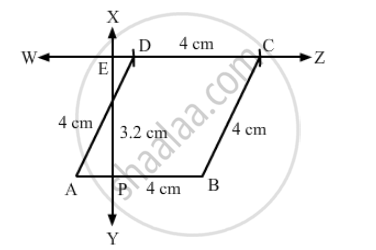
1. Draw a line segment AB of 4 cm.
2. Draw a perpendicular XY on AB, which intersects AB at P.
3. With P as centre, cut PE at 3.2 cm.
4. Draw a line WZ that passes through E. This line should be parallel to AB.
5. With A as centre, draw an arc of radius 4 cm that cuts WZ at D.
6. With D as centre and radius 4 cm, cut line DZ. Label it as point C.
4. Join AD and CB.
संबंधित प्रश्न
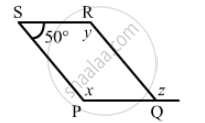
The following figure is parallelogram. Find the degree values of the unknown x, y, z.
Can the following figure be parallelogram. Justify your answer.
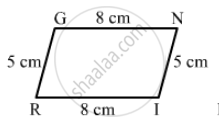
In the following figure GUNS and RUNS are parallelogram. Find x and y.
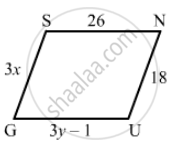
Two adjacent angles of a parallelogram are as 1 : 2. Find the measures of all the angles of the parallelogram.
Two adjacent sides of a parallelogram are 4 cm and 3 cm respectively. Find its perimeter.
Which of the following statement is true for a rhombus?
It has all its sides of equal lengths.
Draw a rhombus, having each side of length 3.5 cm and one of the angles as 40°.
In rhombus ABCD;
(i) if ∠A = 74° ; find ∠B and ∠C.
(ii) if AD = 7.5 cm ; find BC and CD.
If the diagonal of a rhombus are equal, then the rhombus is a
A Rangoli has been drawn on a flor of a house. ABCD and PQRS both are in the shape of a rhombus. Find the radius of semicircle drawn on each side of rhombus ABCD.