Advertisements
Advertisements
प्रश्न
Two adjacent sides of a parallelogram are 4 cm and 3 cm respectively. Find its perimeter.
Advertisements
उत्तर
\[\text{ We know that the opposite sides of a parallelogram are equal } . \]
\[\text{ Two sides are given, i . e . 4 cm and 3 cm } . \]
\[\text{ Therefore, the rest of the sies will also be 4 cm and 3 cm }. \]
\[ \therefore \text{ Perimeter = Sum of all the sides of a parallelogram }\]
\[ = 4 + 3 + 4 + 3\]
\[ = 14 \text{ cm }\]
संबंधित प्रश्न
Name the quadrilaterals whose diagonals are perpendicular bisectors of each other
The following figure is parallelogram. Find the degree values of the unknown x, y, z.
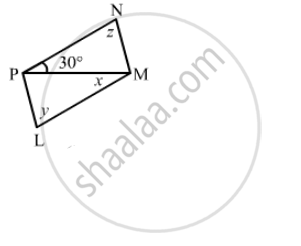
Can the following figure be parallelogram. Justify your answer.
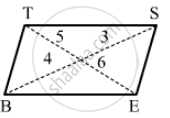
Two opposite angles of a parallelogram are (3x − 2)° and (50 − x)°. Find the measure of each angle of the parallelogram.
If an angle of a parallelogram is two-third of its adjacent angle, find the angles of the parallelogram.
If the diagonals of a rhombus are 12 cm and 16cm, find the length of each side.
Identify all the quadrilateral that have Four sides of equal length
The lengths of the diagonals of a Rhombus are 12 cm and 16 cm. Find the side of the rhombus
If the diagonal of a rhombus are equal, then the rhombus is a
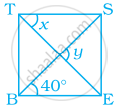
In the figure, BEST is a rhombus, Then the value of y – x is ______.