Advertisements
Advertisements
प्रश्न
Two opposite angles of a parallelogram are (3x − 2)° and (50 − x)°. Find the measure of each angle of the parallelogram.
Advertisements
उत्तर
\[\text{ Oppostie angles of a parallelogram are congurent } . \]
\[ \therefore \left( 3x - 2 \right)° = \left( 50 - x \right)°\]
\[3x°- 2° = 50°- x°\]
\[3x°+ x°= 50° + 2°\]
\[4x°= 52°\]
\[x° = 13°\]
\[\text{ Putting the value of x in one angle }: \]
\[3x° - 2°= 39°- 2°\]
\[ = 37°\]
\[\text{ Opposite angles are congurent }: \]
\[ \therefore 50 - x°\]
\[ = 37°\]
\[\text{ Let the remaining two angles be y and z } . \]
\[\text{ Angles y and z are congurent because they are also opposite angles } . \]
\[ \therefore y = z\]
\[\text{ The sum of adjacent angles of a paralle\logram is equal to } 180° . \]
\[ \therefore 37°+ y = 180°\]
\[y = 180°- 37°\]
\[y = 143°\]
\[\text{ So, the anlges measure are }: \]
\[37°, 37°, 143° \text{ and } 143°\]
संबंधित प्रश्न
Can the following figure be parallelogram. Justify your answer.
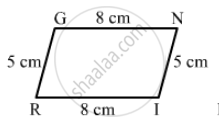
Which of the following statement is true for a rhombus?
It is a square.
Fill in the blank, in the following, so as to make the statement true:
A rhombus is a parallelogram in which ......
Fill in the blank, in the following, so as to make the statement true:
The diagonals of a rhombus ...... each other at ...... angles.
The diagonals of a parallelogram are not perpendicular. Is it a rhombus? Why or why not?
Draw a rhombus ABCD, if AB = 6 cm and AC = 5 cm.
The diagonals of a quadrilateral are of lengths 6 cm and 8 cm. If the diagonals bisect each other at right angles, what is the length of each side of the quadrilateral?
Lengths of diagonals of a rhombus ABCD are 16 cm and 12 cm. Find the side and perimeter of the rhombus.
In a rhombus diagonals intersect at ______ angles.
All rhombuses are squares.
