Advertisements
Advertisements
प्रश्न
In a rhombus diagonals intersect at ______ angles.
Advertisements
उत्तर
In a rhombus diagonals intersect at right angles.
Explanation:
Since all sides are equal in a rhombus so they intersect at right angles.
APPEARS IN
संबंधित प्रश्न
The perimeter of a parallelogram is 150 cm. One of its sides is greater than the other by 25 cm. Find the length of the sides of the parallelogram.
In the following Figure ABCD is a arallelogram, CE bisects ∠C and AF bisects ∠A. In each of the following, if the statement is true, give a reason for the same:
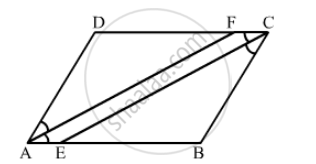
(i) ∠A = ∠C
(ii) \[\angle FAB = \frac{1}{2}\angle A\]
(iii) \[\angle DCE = \frac{1}{2}\angle C\]
(iv) \[\angle CEB = \angle FAB\]
(v) CE || AF
Which of the following statement is true for a rhombus?
Its diagonals are equal and perpendicular.
Which of the following statement is true for a rhombus?
It has all its sides of equal lengths.
The diagonals of a parallelogram are not perpendicular. Is it a rhombus? Why or why not?
The diagonals of a quadrilateral are of lengths 6 cm and 8 cm. If the diagonals bisect each other at right angles, what is the length of each side of the quadrilateral?
Diagonals of a rhombus are 20 cm and 21 cm respectively, then find the side of rhombus and its perimeter.
State with reason whether the following statement is ‘true’ or ‘false’.
Every parallelogram is a rhombus.
If opposite angles of a rhombus are (2x)° and (3x - 40)° then value of x is ______.
Diagonals of a quadrilateral are perpendicular to each other. Is such a quadrilateral always a rhombus? Give a figure to justify your answer.
