Advertisements
Advertisements
प्रश्न
If opposite angles of a rhombus are (2x)° and (3x - 40)° then value of x is ______.
पर्याय
100°
80°
160°
40°
Advertisements
उत्तर
If opposite angles of a rhombus are (2x)° and (3x - 40)° then value of x is 40°.
Explanation:
A rhombus is also a parallelogram so, the opposite angles will be congruent.
Thus, (2x)° = (3x - 40)°
3x - 2x = 40°
x = 40°
APPEARS IN
संबंधित प्रश्न
In the adjacent figure HOPE is a parallelogram. Find the angle measures x,y and z. State the geometrical truths you use to find them.
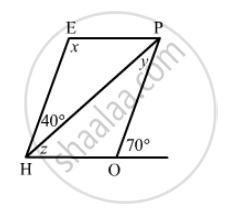
Two adjacent angles of a parallelogram are as 1 : 2. Find the measures of all the angles of the parallelogram.
All the angles of a quadrilateral are equal to each other. Find the measure of each. Is the quadrilateral a parallelogram? What special type of parallelogram is it?
In the following Figure ABCD is a arallelogram, CE bisects ∠C and AF bisects ∠A. In each of the following, if the statement is true, give a reason for the same:
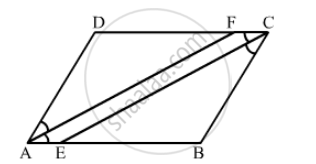
(i) ∠A = ∠C
(ii) \[\angle FAB = \frac{1}{2}\angle A\]
(iii) \[\angle DCE = \frac{1}{2}\angle C\]
(iv) \[\angle CEB = \angle FAB\]
(v) CE || AF
Points E and F lie on diagonal AC of a parallelogram ABCD such that AE = CF. What type of quadrilateral is BFDE?
Which of the following statement is true for a rhombus?
It has two pairs of parallel sides.
Which of the following statement is true for a rhombus?
It has all its sides of equal lengths.
Which of the following statement is true for a rhombus?
It is a parallelogram.
Which of the following statement is true for a rhombus?
It is a square.
Fill in the blank, in the following, so as to make the statement true:
A rhombus is a parallelogram in which ......
Fill in the blank, in the following, so as to make the statement true:
The diagonals of a rhombus ...... each other at ...... angles.
The diagonals of a parallelogram are not perpendicular. Is it a rhombus? Why or why not?
Show that each diagonal of a rhombus bisects the angle through which it passes.
Identify all the quadrilateral that have Four sides of equal length
Draw a rhombus KLMN such that its side is 4 cm and m∠K = 75°.
Lengths of diagonals of a rhombus ABCD are 16 cm and 12 cm. Find the side and perimeter of the rhombus.
Measure of one angle of a rhombus is 50°, find the measures of remaining three angles.
In rhombus ABCD;
(i) if ∠A = 74° ; find ∠B and ∠C.
(ii) if AD = 7.5 cm ; find BC and CD.
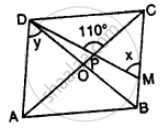
The given figure shows a rhombus ABCD in which angle BCD = 80°. Find angles x and y.
If all sides of a quadrilateral are equal, it is a ______.
