Advertisements
Advertisements
प्रश्न
Adjacent sides of a rectangle are 7 cm and 24 cm. Find the length of its diagonal.
Advertisements
उत्तर

Let `square`ABCD be the rectangle.
AB = 7 cm, BC = 24 cm
In ∆ABC,
∠B = 90° ...[Angle of a rectangle]
From Pythagoras theorem,
AC2 = AB2 + BC2
AC2 = 72 + 242
AC2 = 49 + 576
∴ AC2 = 625
∴ AC = `sqrt(625)`
∴ AC = 25 cm
APPEARS IN
संबंधित प्रश्न
Explain why a rectangle is a convex quadrilateral.
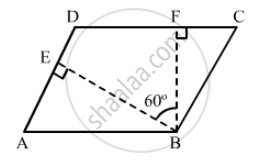
The angle between the altitudes of a parallelogram, through the same vertex of an obtuse angle of the parallelogram is 60°. Find the angles of the parallelogram.
Which of the following statement is true for a rectangle?
It has all its sides of equal length.
Which of the following statement is true for a rectangle?
Its diagonals bisect each other.
Which of the following statement is true for a rectangle?
Its diagonals are perpendicular and bisect each other.
Which of the following statement is true for a rectangle?
Its diagonals are equal and perpendicular, and bisect each other.
Which of the following statement true for a square?
Its diagonals bisect each other at right angle.
Fill in the blank of the following, so as to make the statement true:
A square is a rectangle in which .....
The sides of a rectangle are in the ratio 2 : 3, and its perimeter is 20 cm. Draw the rectangle.
The sides of a rectangle are in the ratio 4 : 5. Find its sides if the perimeter is 90 cm.
Find the length of the diagonal of a rectangle whose sides are 12 cm and 5 cm.
Draw a square whose each side measures 4.8 cm.
Prove that quadrilateral formed by the intersection of angle bisectors of all angles of a parallelogram is a rectangle.

State with reason whether the following statement is ‘true’ or ‘false’.
Every parallelogram is a rectangle.
Draw a rectangle ABCD such that l(AB) = 6.0 cm and l (BC) = 4.5 cm.
If diagonal of a rectangle is 26 cm and one side is 24 cm, find the other side.
A quadrilateral whose opposite sides and all the angles are equal is a ______.
Every parallelogram is a rectangle.
Every rectangle is a trapezium.
Quadrilateral EFGH is a rectangle in which J is the point of intersection of the diagonals. Find the value of x if JF = 8x + 4 and EG = 24x – 8.
