Advertisements
Advertisements
प्रश्न
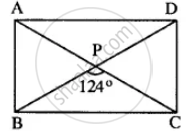
ABCD is a rectangle, if ∠BPC = 124°
Calculate:
- ∠BAP
- ∠ADP
Advertisements
उत्तर
Diagonals of rectangle are equal and bisect each other.
∠PBC = ∠PCB = x (say)
But ∠BPC + ∠PBC + ∠PCB = 180°
124° + x + x = 180°
2x = 180° – 124°
2x = 56°
⇒ x = 28°
∠PBC = 28°
But ∠PBC = ∠ADP [Alternate ∠s]
∠ADP = 28°
Again ∠APB = 180° – 124°
∠APB = 56°
Also, PA = PB
∠BAP = 12 (180° – ∠APB)
= 12 × (180°- 56°)
= 12 × 124°
= 62°
Hence, (i) ∠BAP = 62° (ii) ∠ADP = 28°
APPEARS IN
संबंधित प्रश्न
Explain why a rectangle is a convex quadrilateral.
The shorter side of a parallelogram is 4.8 cm and the longer side is half as much again as the shorter side. Find the perimeter of the parallelogram.
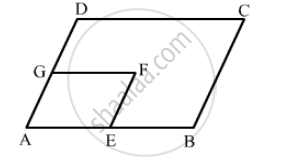
In the following figure, ABCD and AEFG are parallelograms. If ∠C = 55°, what is the measure of ∠F?
Which of the following statement is true for a rectangle?
It has all its sides of equal length.
Using opposite angles test for parallelogram, prove that every rectangle is a parallelogram.
If the diagonals of a parallelogram are of equal lengths, the parallelogram is a rectangle. Prove it.
Show that the bisectors of angles of a parallelogram form a rectangle
For which of the following figures, diagonals are equal?
A quadrilateral whose opposite sides and all the angles are equal is a ______.
Every parallelogram is a rectangle.
