Advertisements
Advertisements
प्रश्न
The sides of a rectangle are in the ratio 2 : 3, and its perimeter is 20 cm. Draw the rectangle.
Advertisements
उत्तर
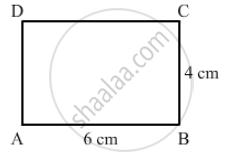
\[\text{ Let the side be x cm and y cm } . \]
\[\text{ So, we have }: \]
\[ 2\left( x + y \right) = 20 \]
\[\text{ Sides are in the ratio 2: 3 } . \]
\[ \therefore y = \frac{3x}{2}\]
\[\text{ Putting the value of y }: \]
\[2\left( x + \frac{3x}{2} \right) = 20 \]
\[\frac{2x + 3x}{2} = 10\]
\[5x = 20\]
\[x = 4\]
\[ \therefore y = \frac{3 \times 4}{2} = 6\]
\[\text{ Thus, sides of the rectangle will be 4 cm and 6 cm } . \]
\[\text{ ABCD is the rectangle having sides 4 cm and 6 cm } .\]
संबंधित प्रश्न
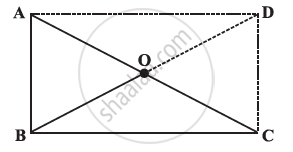
ABC is a right-angled triangle and O is the mid point of the side opposite to the right angle. Explain why O is equidistant from A, B and C. (The dotted lines are drawn additionally to help you)
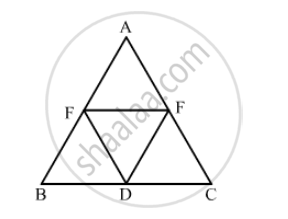
In the following figure, BDEF and DCEF are each a parallelogram. Is it true that BD = DC? Why or why not?
Which of the following statement is true for a rectangle?
It has all its sides of equal length.
In a rectangle ABCD, prove that ∆ACB ≅ ∆CAD.
Draw a rectangle whose one side measures 8 cm and the length of each of whose diagonals is 10 cm.
Draw a square whose each side measures 4.8 cm.
State with reason whether the following statement is ‘true’ or ‘false’.
Every parallelogram is a rectangle.
If the adjacent angles of a parallelogram are equal, then the parallelogram is a ______.
PQRS is a rectangle. The perpendicular ST from S on PR divides ∠S in the ratio 2:3. Find ∠TPQ.
Quadrilateral EFGH is a rectangle in which J is the point of intersection of the diagonals. Find the value of x if JF = 8x + 4 and EG = 24x – 8.
