Advertisements
Advertisements
प्रश्न
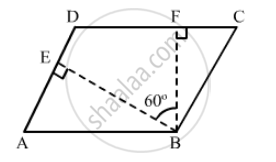
The angle between the altitudes of a parallelogram, through the same vertex of an obtuse angle of the parallelogram is 60°. Find the angles of the parallelogram.
Advertisements
उत्तर
\[\text{ Draw a parallelogram ABCD } . \]
\[\text{ Drop a perpendicular from B to the side AD, at the point E } . \]
\[\text{ Drop perpendicular from B to the side CD, at the point F } . \]
\[\text{ In the quadrilateral BEDF }: \]
\[\angle EBF = 60°, \angle BED = 90°\]
\[\angle BFD = 90°e \]
\[\angle EDF = 360° - (60° + 90° + 90°) = 120°\]
\[\text{ In a parallelogram, opposite angles are congruent and adjacent angles are supplementary } . \]
\[\text{ In the parallelogram ABCD }: \]
\[\angle B = \angle D = 120° \]
\[\angle A = \angle C = 180°e - 120° = 60 °\]
संबंधित प्रश्न
Diagonals of a parallelogram ABCD intersect at O. AL and CM are drawn perpendiculars to BD such that L and M lie on BD. Is AL = CM? Why or why not?
Which of the following statement is true for a rectangle?
All rectangles are squares.
Fill in the blank of the following, so as to make the statement true:
A square is a rectangle in which .....
Find the length of the diagonal of a rectangle whose sides are 12 cm and 5 cm.
Draw a rectangle ABCD such that l(AB) = 6.0 cm and l (BC) = 4.5 cm.
For which of the following figures, diagonals are equal?
A parallelogram PQRS is constructed with sides QR = 6 cm, PQ = 4 cm and ∠PQR = 90°. Then PQRS is a ______.
Every parallelogram is a rectangle.
In a rectangle ABCD, AB = 25 cm and BC = 15. In what ratio does the bisector of ∠C divide AB?
Quadrilateral EFGH is a rectangle in which J is the point of intersection of the diagonals. Find the value of x if JF = 8x + 4 and EG = 24x – 8.
