Advertisements
Advertisements
Question
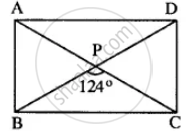
ABCD is a rectangle, if ∠BPC = 124°
Calculate:
- ∠BAP
- ∠ADP
Advertisements
Solution
Diagonals of rectangle are equal and bisect each other.
∠PBC = ∠PCB = x (say)
But ∠BPC + ∠PBC + ∠PCB = 180°
124° + x + x = 180°
2x = 180° – 124°
2x = 56°
⇒ x = 28°
∠PBC = 28°
But ∠PBC = ∠ADP [Alternate ∠s]
∠ADP = 28°
Again ∠APB = 180° – 124°
∠APB = 56°
Also, PA = PB
∠BAP = 12 (180° – ∠APB)
= 12 × (180°- 56°)
= 12 × 124°
= 62°
Hence, (i) ∠BAP = 62° (ii) ∠ADP = 28°
APPEARS IN
RELATED QUESTIONS
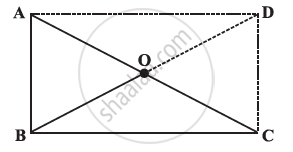
ABC is a right-angled triangle and O is the mid point of the side opposite to the right angle. Explain why O is equidistant from A, B and C. (The dotted lines are drawn additionally to help you)
In a parallelogram ABCD, the diagonals bisect each other at O. If ∠ABC = 30°, ∠BDC = 10° and ∠CAB = 70°. Find:
∠DAB, ∠ADC, ∠BCD, ∠AOD, ∠DOC, ∠BOC, ∠AOB, ∠ACD, ∠CAB, ∠ADB, ∠ACB, ∠DBC and ∠DBA.
Diagonals of a parallelogram ABCD intersect at O. AL and CM are drawn perpendiculars to BD such that L and M lie on BD. Is AL = CM? Why or why not?
Which of the following statement is true for a rectangle?
It has two pairs of equal sides.
Which of the following statement is true for a rectangle?
Its diagonals are perpendicular.
The sides of a rectangle are in the ratio 4 : 5. Find its sides if the perimeter is 90 cm.
If diagonal of a rectangle is 26 cm and one side is 24 cm, find the other side.
If the diagonals of a parallelogram are of equal lengths, the parallelogram is a rectangle. Prove it.
A rectangular MORE is shown below:

Answer the following questions by giving appropriate reason.
- Is RE = OM?
- Is ∠MYO = ∠RXE?
- Is ∠MOY = ∠REX?
- Is ΔMYO ≅ ΔRXE?
- Is MY = RX?
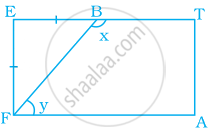
A playground is in the form of a rectangle ATEF. Two players are standing at the points F and B where EF = EB. Find the values of x and y.