Advertisements
Advertisements
प्रश्न
The perimeter of a parallelogram is 150 cm. One of its sides is greater than the other by 25 cm. Find the length of the sides of the parallelogram.
Advertisements
उत्तर
\[\text{ Opposite sides of a parallelogram are same } . \]
\[\text{ Let two sides of the parallelogram be x and y } . \]
\[\text{ Given }: \]
\[ x = y + 25\]
\[\text{ Also }, x + y + x + y = 150 (\text{ Perimeter = Sum of all the sides of a paralle\logram })\]
\[y + 25 + y + y + 25 + y = 150\]
\[4y = 150 - 50\]
\[4y = 100\]
\[y = \frac{100}{4} = 25\]
\[ \therefore x = y + 25 = 25 + 25 = 50 \]
\[\text{ Thus, the lengths of the sides of the parallelogram are 50 cm and 25 cm } .\]
संबंधित प्रश्न
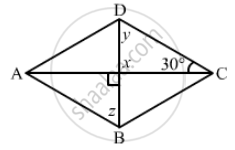
The following figure is parallelogram. Find the degree values of the unknown x, y, z.
The measure of one angle of a parallelogram is 70°. What are the measures of the remaining angles?
The sum of two opposite angles of a parallelogram is 130°. Find all the angles of the parallelogram.
Points E and F lie on diagonal AC of a parallelogram ABCD such that AE = CF. What type of quadrilateral is BFDE?
Which of the following statement is true for a rhombus?
It has only two pairs of equal sides.
Draw a rhombus ABCD, if AB = 6 cm and AC = 5 cm.
Identify all the quadrilateral that have Four sides of equal length
In a rhombus PQRS if PQ = 7.5 cm then find QR. If ∠QPS = 75° then find the measure of ∠PQR and ∠SRQ.
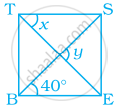
In the figure, BEST is a rhombus, Then the value of y – x is ______.
Diagonals of a quadrilateral are perpendicular to each other. Is such a quadrilateral always a rhombus? Give a figure to justify your answer.
