Advertisements
Advertisements
प्रश्न
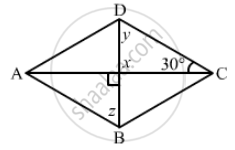
The following figure is parallelogram. Find the degree values of the unknown x, y, z.
Advertisements
उत्तर
\[ x = 90° (\text{ vertically opposite angle })\]
\[\text{ Sum of all angles in a triangle is } {180}^°. \]
\[ \therefore y + 90°+ 30° = 180°\]
\[y = 180°- (90°+ 30°) = 60°\]
\[y = z = 60° (\text{ alternate angles })\]
संबंधित प्रश्न
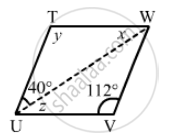
The following figure is parallelogram. Find the degree value of the unknown x, y, z.
If an angle of a parallelogram is two-third of its adjacent angle, find the angles of the parallelogram.
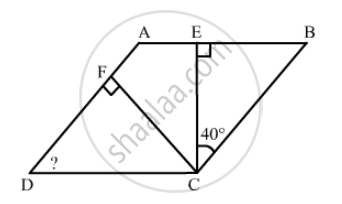
Find the angles marked with a question mark shown in Fig. 17.27
Which of the following statement is true for a rhombus?
It has two pairs of equal sides.
Which of the following statement is true for a rhombus?
Its diagonals bisect each other at right angles.
Which of the following statement is true for a rhombus?
It has all its sides of equal lengths.
The diagonals of a parallelogram are not perpendicular. Is it a rhombus? Why or why not?
Draw a rhombus, having each side of length 3.5 cm and one of the angles as 40°.
Lengths of diagonals of a rhombus ABCD are 16 cm and 12 cm. Find the side and perimeter of the rhombus.
A quadrilateral whose all sides are equal, opposite angles are equal and the diagonals bisect each other at right angles is a ______.
