Advertisements
Advertisements
प्रश्न
Draw a rhombus ABCD, if AB = 6 cm and AC = 5 cm.
Advertisements
उत्तर
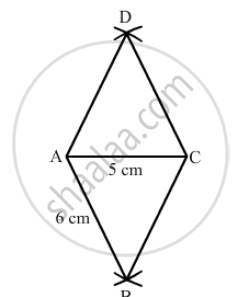
1. Draw a line segment AC of 5 cm.
2. With A as centre, draw an arc of radius 6 cm on each side of AC.
3. With C as centre, draw an arc of radius 6 cm on each side of AC. These arcs intersect the arcs of step 2 at B and D.
4. Join AB, AD, CD and CB.
संबंधित प्रश्न
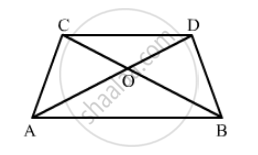
Given below is a parallelogram ABCD. Complete each statement along with the definition or property used.
(i) AD =
(ii) ∠DCB =
(iii) OC =
(iv) ∠DAB + ∠CDA =
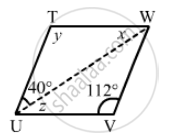
The following figure is parallelogram. Find the degree value of the unknown x, y, z.
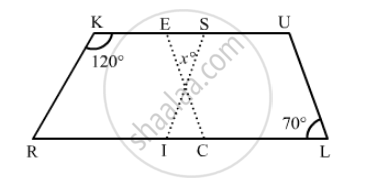
In the following figure RISK and CLUE are parallelograms. Find the measure of x.
In the following Figure ABCD is a arallelogram, CE bisects ∠C and AF bisects ∠A. In each of the following, if the statement is true, give a reason for the same:
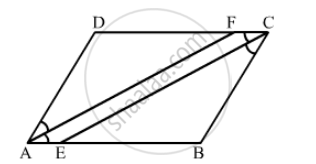
(i) ∠A = ∠C
(ii) \[\angle FAB = \frac{1}{2}\angle A\]
(iii) \[\angle DCE = \frac{1}{2}\angle C\]
(iv) \[\angle CEB = \angle FAB\]
(v) CE || AF
Which of the following statement is true for a rhombus?
It has only two pairs of equal sides.
The diagonals of a quadrilateral are of lengths 6 cm and 8 cm. If the diagonals bisect each other at right angles, what is the length of each side of the quadrilateral?
Diagonals of a rhombus are 20 cm and 21 cm respectively, then find the side of rhombus and its perimeter.
The given figure shows a rhombus ABCD in which angle BCD = 80°. Find angles x and y.
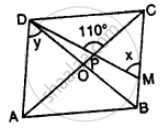
If a diagonal of a quadrilateral bisects both the angles, then it is a ______.
Construct a rhombus CLUE in which CL = 7.5 cm and LE = 6 cm.
