Advertisements
Advertisements
प्रश्न
Construct a rhombus CLUE in which CL = 7.5 cm and LE = 6 cm.
Advertisements
उत्तर
We know that, all sides of a rhombus are equal and opposite sides are parallel to each other.
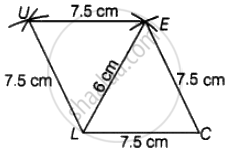
Steps of construction:
Step I: Draw a line segment CL = 7.5 cm.
Step II: With C as a centre, draw an arc CE = 7.5 cm.
Step III: With L as a centre, draw an another arc LU = 7.5 cm.
Step IV: Now, with centre L, draw an arc LE = 6 cm, that is cut-off previous arc CE.
Step V: With E as a centre, draw an arc UE = 7.5 cm, that is cut-off previous arc LU.
Step VI: Now join UL, CE and EU.
Hence, CLUE is a required rhombus.
APPEARS IN
संबंधित प्रश्न
The sum of two opposite angles of a parallelogram is 130°. Find all the angles of the parallelogram.
The perimeter of a parallelogram is 150 cm. One of its sides is greater than the other by 25 cm. Find the length of the sides of the parallelogram.
In a parallelogram ABCD, AB = 10 cm, AD = 6 cm. The bisector of ∠A meets DC in E, AEand BC produced meet at F. Find te length CF.
Which of the following statement is true for a rhombus?
It has two pairs of equal sides.
ABCD is a rhombus. If ∠ACB = 40°, find ∠ADB.
Identify all the quadrilateral that have Four sides of equal length
Diagonals of a rhombus are 20 cm and 21 cm respectively, then find the side of rhombus and its perimeter.
State with reason whether the following statement is ‘true’ or ‘false’.
Every rhombus is a rectangle.
In a rhombus diagonals intersect at ______ angles.
ABCD is a rhombus such that the perpendicular bisector of AB passes through D. Find the angles of the rhombus.
Hint: Join BD. Then ∆ABD is equilateral.
