Advertisements
Advertisements
प्रश्न
Construct a rhombus CLUE in which CL = 7.5 cm and LE = 6 cm.
Advertisements
उत्तर
We know that, all sides of a rhombus are equal and opposite sides are parallel to each other.
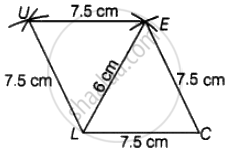
Steps of construction:
Step I: Draw a line segment CL = 7.5 cm.
Step II: With C as a centre, draw an arc CE = 7.5 cm.
Step III: With L as a centre, draw an another arc LU = 7.5 cm.
Step IV: Now, with centre L, draw an arc LE = 6 cm, that is cut-off previous arc CE.
Step V: With E as a centre, draw an arc UE = 7.5 cm, that is cut-off previous arc LU.
Step VI: Now join UL, CE and EU.
Hence, CLUE is a required rhombus.
APPEARS IN
संबंधित प्रश्न
All rhombuses are parallelograms.
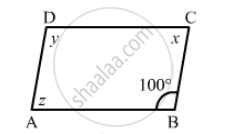
The following figure is parallelogram. Find the degree values of the unknowns x, y, z.
If an angle of a parallelogram is two-third of its adjacent angle, find the angles of the parallelogram.
Which of the following statement is true for a rhombus?
Two of its angles are at right angles
ABCD is a rhombus. If ∠ACB = 40°, find ∠ADB.
Construct a rhombus whose diagonals are of length 10 cm and 6 cm.
Draw a rhombus, having each side of length 3.5 cm and one of the angles as 40°.
Identify all the quadrilateral that have Four sides of equal length
In a rhombus PQRS if PQ = 7.5 cm then find QR. If ∠QPS = 75° then find the measure of ∠PQR and ∠SRQ.
If the adjacent sides of a parallelogram are equal then parallelogram is a ______.
