Advertisements
Advertisements
प्रश्न
ABCD is a rhombus. If ∠ACB = 40°, find ∠ADB.
Advertisements
उत्तर
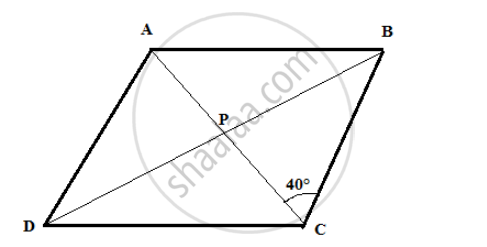
\[\text{ In a rhombus, the diagonals are perpendicular } . \]
\[ \therefore \angle BPC = 90°\]
\[\text{ From ∆ BPC, the sum of angles is }180° . \]
\[ \therefore \angle CBP + \angle BPC + \angle PBC = 180°\]
\[\angle CBP = 180° - \angle BPC - \angle PBC\]
\[\angle CBP = 180° - 40° - 90° = 50° \]
\[\angle ADB = \angle CBP = 50°(\text{ alternate angle })\]
संबंधित प्रश्न
All rhombuses are parallelograms.
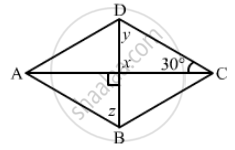
The following figure is parallelogram. Find the degree values of the unknown x, y, z.
Two opposite angles of a parallelogram are (3x − 2)° and (50 − x)°. Find the measure of each angle of the parallelogram.
If an angle of a parallelogram is two-third of its adjacent angle, find the angles of the parallelogram.
Which of the following statement is true for a rectangle?
Its diagonals are equal and bisect each other.
Diagonals of a parallelogram intersect each other at point O. If AO = 5, BO = 12 and AB = 13 then show that `square`ABCD is a rhombus.
Measure of one angle of a rhombus is 50°, find the measures of remaining three angles.
The given figure shows a rhombus ABCD in which angle BCD = 80°. Find angles x and y.
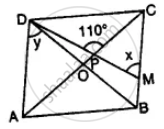
Diagonals of a quadrilateral are perpendicular to each other. Is such a quadrilateral always a rhombus? Give a figure to justify your answer.
Construct a rhombus whose side is 5 cm and one angle is of 60°.
