Advertisements
Advertisements
प्रश्न
Name the quadrilaterals whose diagonals are perpendicular bisectors of each other
Advertisements
उत्तर
The diagonals of a rhombus and square act as perpendicular bisectors.
संबंधित प्रश्न
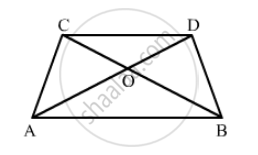
Given below is a parallelogram ABCD. Complete each statement along with the definition or property used.
(i) AD =
(ii) ∠DCB =
(iii) OC =
(iv) ∠DAB + ∠CDA =
The sum of two opposite angles of a parallelogram is 130°. Find all the angles of the parallelogram.
Two adjacent sides of a parallelogram are 4 cm and 3 cm respectively. Find its perimeter.
In the following Figure ABCD is a arallelogram, CE bisects ∠C and AF bisects ∠A. In each of the following, if the statement is true, give a reason for the same:
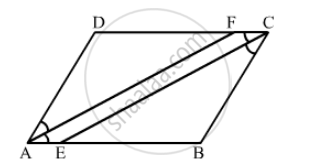
(i) ∠A = ∠C
(ii) \[\angle FAB = \frac{1}{2}\angle A\]
(iii) \[\angle DCE = \frac{1}{2}\angle C\]
(iv) \[\angle CEB = \angle FAB\]
(v) CE || AF
Which of the following statement is true for a rhombus?
Its diagonals are equal and perpendicular.
The diagonals of a quadrilateral are of lengths 6 cm and 8 cm. If the diagonals bisect each other at right angles, what is the length of each side of the quadrilateral?
If all pairs of adjacent sides of a quadrilateral are congruent then it is called ______.
Diagonals PR and QS of a rhombus PQRS are 20 cm and 48 cm respectively. Find the length of side PQ.
In rhombus ABCD;
(i) if ∠A = 74° ; find ∠B and ∠C.
(ii) if AD = 7.5 cm ; find BC and CD.
Construct a rhombus CLUE in which CL = 7.5 cm and LE = 6 cm.
