Advertisements
Advertisements
प्रश्न
Fill in the blank, in the following, so as to make the statement true:
The diagonals of a rhombus ...... each other at ...... angles.
Advertisements
उत्तर
The diagonals of a rhombus bisect each other at right angles.
संबंधित प्रश्न
The measure of one angle of a parallelogram is 70°. What are the measures of the remaining angles?
In a parallelogram ABCD, ∠D = 135°, determine the measure of ∠A and ∠B.
Which of the following statement is true for a rhombus?
It is a square.
Which of the following statement is true for a rectangle?
Its diagonals are equal and bisect each other.
Diagonals of a parallelogram intersect each other at point O. If AO = 5, BO = 12 and AB = 13 then show that `square`ABCD is a rhombus.
State with reason whether the following statement is ‘true’ or ‘false’.
Every rhombus is a rectangle.
The given figure shows a rhombus ABCD in which angle BCD = 80°. Find angles x and y.
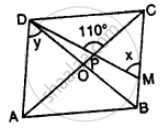
The lengths of the diagonals of a Rhombus are 12 cm and 16 cm. Find the side of the rhombus
A quadrilateral whose all sides are equal, opposite angles are equal and the diagonals bisect each other at right angles is a ______.
ABCD is a rhombus such that the perpendicular bisector of AB passes through D. Find the angles of the rhombus.
Hint: Join BD. Then ∆ABD is equilateral.
