Advertisements
Advertisements
प्रश्न
Which of the following statement is true for a rhombus?
Its diagonals are equal and perpendicular.
Advertisements
उत्तर
False
Diagonals of a rhombus are perpendicular, but not equal.
संबंधित प्रश्न
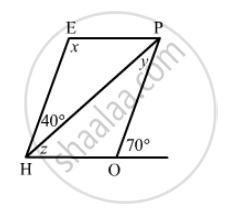
In the adjacent figure HOPE is a parallelogram. Find the angle measures x,y and z. State the geometrical truths you use to find them.
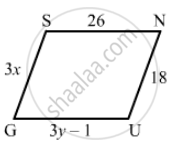
In the following figure GUNS and RUNS are parallelogram. Find x and y.
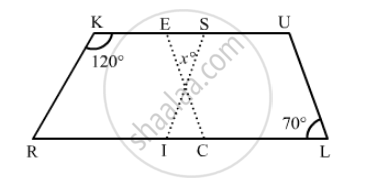
In the following figure RISK and CLUE are parallelograms. Find the measure of x.
The sum of two opposite angles of a parallelogram is 130°. Find all the angles of the parallelogram.
In a parallelogram ABCD, AB = 10 cm, AD = 6 cm. The bisector of ∠A meets DC in E, AEand BC produced meet at F. Find te length CF.
Which of the following statement is true for a rhombus?
It has two pairs of equal sides.
ABCD is a rhombus. If ∠ACB = 40°, find ∠ADB.
ABCD is a rhombus whose diagonals intersect at O. If AB = 10 cm, diagonal BD = 16 cm, find the length of diagonal AC.
The diagonals of a quadrilateral are of lengths 6 cm and 8 cm. If the diagonals bisect each other at right angles, what is the length of each side of the quadrilateral?
All rhombuses are squares.
