Advertisements
Advertisements
Question
In a rhombus diagonals intersect at ______ angles.
Advertisements
Solution
In a rhombus diagonals intersect at right angles.
Explanation:
Since all sides are equal in a rhombus so they intersect at right angles.
APPEARS IN
RELATED QUESTIONS
All rhombuses are parallelograms.
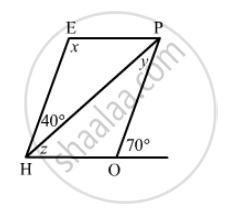
In the adjacent figure HOPE is a parallelogram. Find the angle measures x,y and z. State the geometrical truths you use to find them.
Which of the following statement is true for a rhombus?
It is a square.
Fill in the blank, in the following, so as to make the statement true:
The diagonals of a rhombus ...... each other at ...... angles.
Draw a rhombus ABCD, if AB = 6 cm and AC = 5 cm.
Which of the following statement is true for a rectangle?
Its diagonals are equal and bisect each other.
A quadrilateral whose all sides are equal, opposite angles are equal and the diagonals bisect each other at right angles is a ______.
All rhombuses are squares.
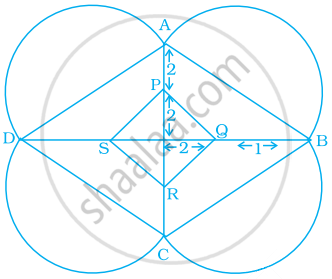
A Rangoli has been drawn on a flor of a house. ABCD and PQRS both are in the shape of a rhombus. Find the radius of semicircle drawn on each side of rhombus ABCD.
ABCD is a rhombus such that the perpendicular bisector of AB passes through D. Find the angles of the rhombus.
Hint: Join BD. Then ∆ABD is equilateral.
