Advertisements
Advertisements
Question
If the adjacent sides of a parallelogram are equal then parallelogram is a ______.
Options
rectangle
trapezium
rhombus
square
Advertisements
Solution
If the adjacent sides of a parallelogram are equal then parallelogram is a rhombus.
Explanation:
In parallelogram the opposite sides are equal. When the adjacent sides becomes equal all the sides of the parallelogram becomes equal and hence it becomes a rhombus.
APPEARS IN
RELATED QUESTIONS
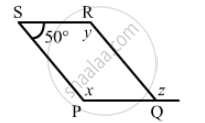
The following figure is parallelogram. Find the degree values of the unknown x, y, z.
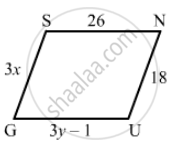
In the following figure GUNS and RUNS are parallelogram. Find x and y.
The measure of one angle of a parallelogram is 70°. What are the measures of the remaining angles?
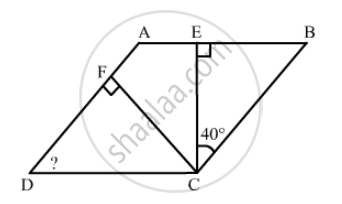
Find the angles marked with a question mark shown in Fig. 17.27
Points E and F lie on diagonal AC of a parallelogram ABCD such that AE = CF. What type of quadrilateral is BFDE?
In a parallelogram ABCD, AB = 10 cm, AD = 6 cm. The bisector of ∠A meets DC in E, AEand BC produced meet at F. Find te length CF.
Draw a rhombus, having each side of length 3.5 cm and one of the angles as 40°.
If the diagonal of a rhombus are equal, then the rhombus is a
A quadrilateral whose all sides are equal, opposite angles are equal and the diagonals bisect each other at right angles is a ______.
Construct a rhombus CLUE in which CL = 7.5 cm and LE = 6 cm.
