Advertisements
Advertisements
Question
If the diagonals of a quadrilateral are equal and bisect each other, then the quadrilateral is a ______.
Options
rhombus
rectangle
square
parallelogram
Advertisements
Solution
If the diagonals of a quadrilateral are equal and bisect each other, then the quadrilateral is a rectangle.
Explanation:
Since, diagonals are equal and bisect each other, therefore it will be a rectangle.
APPEARS IN
RELATED QUESTIONS
In a parallelogram ABCD, the diagonals bisect each other at O. If ∠ABC = 30°, ∠BDC = 10° and ∠CAB = 70°. Find:
∠DAB, ∠ADC, ∠BCD, ∠AOD, ∠DOC, ∠BOC, ∠AOB, ∠ACD, ∠CAB, ∠ADB, ∠ACB, ∠DBC and ∠DBA.
Which of the following statement is true for a square?
It is a rectangle.
Which of the following statement are true for a square?
It has all its sides of equal length.
Find the length of the diagonal of a rectangle whose sides are 12 cm and 5 cm.
Diagonals of a rectangle ABCD intersect at point O. If AC = 8 cm then find BO and if ∠CAD =35° then find ∠ACB.
If diagonal of a rectangle is 26 cm and one side is 24 cm, find the other side.
If the diagonals of a parallelogram are of equal lengths, the parallelogram is a rectangle. Prove it.
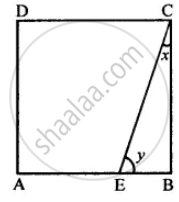
The following figure is a rectangle in which x: y = 3: 7; find the values of x and y.
If the adjacent angles of a parallelogram are equal, then the parallelogram is a ______.
Every rectangle is a trapezium.
