Advertisements
Advertisements
Question
The diagonals of a quadrilateral are of lengths 6 cm and 8 cm. If the diagonals bisect each other at right angles, what is the length of each side of the quadrilateral?
Advertisements
Solution
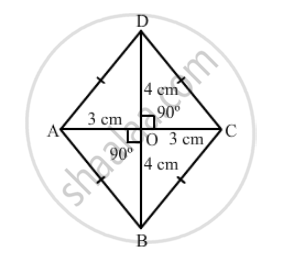
\[\text{ Let the given quadrilateral be ABCD in which diagonals AC is equal to 6 cm and BD is equal to 8 cm }. \]
\[\text{ Also, it is given that the diagonals bisect each other at right angle, at point O }. \]
\[ \therefore AO = OC = \frac{1}{2}AC = 3 cm\]
\[\text{ Also }, OB = OD = \frac{1}{2}BD = 4 cm\]
\[\text{ In right }\bigtriangleup AOB: \]
\[ {AB}^2 = {OA}^2 + {OB}^2 \]
\[ \Rightarrow {AB}^2 = (9 + 16) {cm}^2 \]
\[ \Rightarrow {AB}^2 = 25 {cm}^2 \]
\[ \Rightarrow AB = 5 cm\]
\[\text{ Thus, the length of each side of the quadrilateral is 5 cm } . \]
\[\]
RELATED QUESTIONS
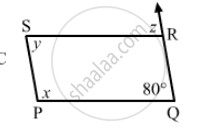
The following figure is parallelogram. Find the degree values of the unknown x, y, z.
Two adjacent sides of a parallelogram are 4 cm and 3 cm respectively. Find its perimeter.
Fill in the blank, inthe following, so as to make the statement true:
A square is a rhombus in which .....
Fill in the blank, in the following, so as to make the statement true:
The diagonals of a rhombus ...... each other at ...... angles.
The diagonals of a quadrilateral are perpendicular to each other. Is such a quadrilateral always a rhombus? If your answer is 'No', draw a figure to justify your answer.
Draw a rhombus, having each side of length 3.5 cm and one of the angles as 40°.
Lengths of diagonals of a rhombus ABCD are 16 cm and 12 cm. Find the side and perimeter of the rhombus.
If the adjacent sides of a parallelogram are equal then parallelogram is a ______.
If all sides of a quadrilateral are equal, it is a ______.
All rhombuses are squares.
