Advertisements
Advertisements
Question
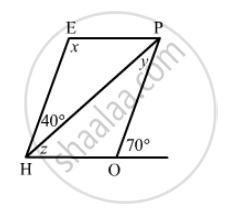
In the adjacent figure HOPE is a parallelogram. Find the angle measures x,y and z. State the geometrical truths you use to find them.
Advertisements
Solution
\[\angle HOP + 70°= 180° (\text{ linear pair })\]
\[\angle HOP = 180°- 70°= 110°\]
\[x = \angle HOP = 110° (\text{ opposite angles of a parallelogram are equal })\]
\[\angle EHP + \angle HEP = 180°(\text{ sum of adjacent angles of a parallelogram is } 180°)\]
\[110° + 40° + z = 180°\]
\[z = 180° - 150°= 30°\]
\[y = 40° \left( \text{ alternate angles }\right)\]
RELATED QUESTIONS
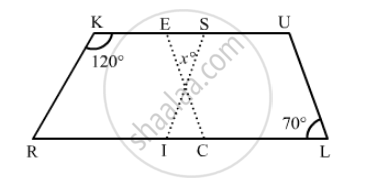
In the following figure RISK and CLUE are parallelograms. Find the measure of x.
The measure of one angle of a parallelogram is 70°. What are the measures of the remaining angles?
Points E and F lie on diagonal AC of a parallelogram ABCD such that AE = CF. What type of quadrilateral is BFDE?
The diagonals of a parallelogram are not perpendicular. Is it a rhombus? Why or why not?
If the diagonals of a rhombus are 12 cm and 16cm, find the length of each side.
Draw a rhombus, having each side of length 3.5 cm and one of the angles as 40°.
Draw a rhombus ABCD, if AB = 6 cm and AC = 5 cm.
State with reason whether the following statement is ‘true’ or ‘false’.
Every rhombus is a rectangle.
If the adjacent sides of a parallelogram are equal then parallelogram is a ______.
A rhombus is a parallelogram in which ______ sides are equal.
