Advertisements
Advertisements
प्रश्न
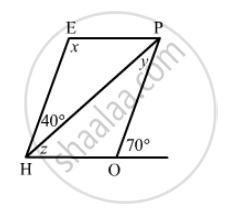
In the adjacent figure HOPE is a parallelogram. Find the angle measures x,y and z. State the geometrical truths you use to find them.
Advertisements
उत्तर
\[\angle HOP + 70°= 180° (\text{ linear pair })\]
\[\angle HOP = 180°- 70°= 110°\]
\[x = \angle HOP = 110° (\text{ opposite angles of a parallelogram are equal })\]
\[\angle EHP + \angle HEP = 180°(\text{ sum of adjacent angles of a parallelogram is } 180°)\]
\[110° + 40° + z = 180°\]
\[z = 180° - 150°= 30°\]
\[y = 40° \left( \text{ alternate angles }\right)\]
संबंधित प्रश्न
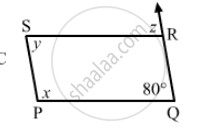
The following figure is parallelogram. Find the degree values of the unknown x, y, z.
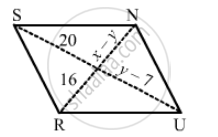
In the following figure GUNS and RUNS are parallelogram. Find x and y.
In a parallelogram ABCD, AB = 10 cm, AD = 6 cm. The bisector of ∠A meets DC in E, AEand BC produced meet at F. Find te length CF.
Which of the following statement is true for a rhombus?
It has two pairs of parallel sides.
Fill in the blank, in the following, so as to make the statement true:
A rhombus is a parallelogram in which ......
ABCD is a rhombus. If ∠ACB = 40°, find ∠ADB.
The diagonals of a quadrilateral are of lengths 6 cm and 8 cm. If the diagonals bisect each other at right angles, what is the length of each side of the quadrilateral?
The lengths of the diagonals of a Rhombus are 12 cm and 16 cm. Find the side of the rhombus
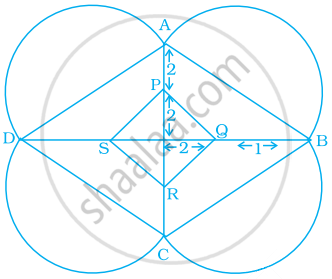
A Rangoli has been drawn on a flor of a house. ABCD and PQRS both are in the shape of a rhombus. Find the radius of semicircle drawn on each side of rhombus ABCD.
ABCD is a rhombus such that the perpendicular bisector of AB passes through D. Find the angles of the rhombus.
Hint: Join BD. Then ∆ABD is equilateral.
