Advertisements
Advertisements
Question
Two adjacent sides of a parallelogram are 4 cm and 3 cm respectively. Find its perimeter.
Advertisements
Solution
\[\text{ We know that the opposite sides of a parallelogram are equal } . \]
\[\text{ Two sides are given, i . e . 4 cm and 3 cm } . \]
\[\text{ Therefore, the rest of the sies will also be 4 cm and 3 cm }. \]
\[ \therefore \text{ Perimeter = Sum of all the sides of a parallelogram }\]
\[ = 4 + 3 + 4 + 3\]
\[ = 14 \text{ cm }\]
RELATED QUESTIONS
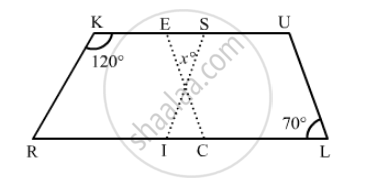
In the following figure RISK and CLUE are parallelograms. Find the measure of x.
In a parallelogram ABCD, ∠D = 135°, determine the measure of ∠A and ∠B.
ABCD is a parallelogram in which ∠A = 70°. Compute ∠B, ∠C and ∠D.
Which of the following statement is true for a rhombus?
Its diagonals bisect each other at right angles.
The diagonals of a parallelogram are not perpendicular. Is it a rhombus? Why or why not?
Draw a rhombus KLMN such that its side is 4 cm and m∠K = 75°.
In rhombus ABCD;
(i) if ∠A = 74° ; find ∠B and ∠C.
(ii) if AD = 7.5 cm ; find BC and CD.
If all sides of a quadrilateral are equal, it is a ______.
ABCD is a rhombus such that the perpendicular bisector of AB passes through D. Find the angles of the rhombus.
Hint: Join BD. Then ∆ABD is equilateral.
Construct a rhombus CLUE in which CL = 7.5 cm and LE = 6 cm.
