Advertisements
Advertisements
Question
State with reason whether the following statement is ‘true’ or ‘false’.
Every parallelogram is a rhombus.
Options
True
False
Advertisements
Solution
This statement is False.
Reason:
All the sides of a rhombus are congruent, while the opposite sides of a parallelogram are congruent.
APPEARS IN
RELATED QUESTIONS
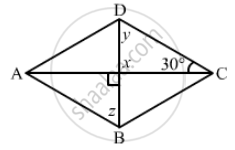
The following figure is parallelogram. Find the degree values of the unknown x, y, z.
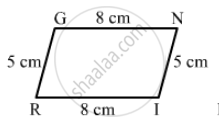
Can the following figure be parallelogram. Justify your answer.
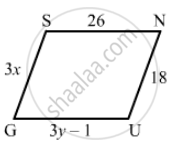
In the following figure GUNS and RUNS are parallelogram. Find x and y.
The perimeter of a parallelogram is 150 cm. One of its sides is greater than the other by 25 cm. Find the length of the sides of the parallelogram.
In the following Figure ABCD is a arallelogram, CE bisects ∠C and AF bisects ∠A. In each of the following, if the statement is true, give a reason for the same:
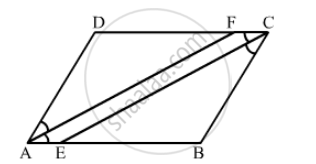
(i) ∠A = ∠C
(ii) \[\angle FAB = \frac{1}{2}\angle A\]
(iii) \[\angle DCE = \frac{1}{2}\angle C\]
(iv) \[\angle CEB = \angle FAB\]
(v) CE || AF
Points E and F lie on diagonal AC of a parallelogram ABCD such that AE = CF. What type of quadrilateral is BFDE?
Which of the following statement is true for a rhombus?
It has two pairs of parallel sides.
Which of the following statement is true for a rhombus?
It has all its sides of equal lengths.
Fill in the blank, in the following, so as to make the statement true:
A rhombus is a parallelogram in which ......
One side of a rhombus is of length 4 cm and the length of an altitude is 3.2 cm. Draw the rhombus.
ABCD is a rhombus whose diagonals intersect at O. If AB = 10 cm, diagonal BD = 16 cm, find the length of diagonal AC.
Which of the following statement is true for a rectangle?
Its diagonals are equal and bisect each other.
Diagonals of a parallelogram intersect each other at point O. If AO = 5, BO = 12 and AB = 13 then show that `square`ABCD is a rhombus.
Lengths of diagonals of a rhombus ABCD are 16 cm and 12 cm. Find the side and perimeter of the rhombus.
Measure of one angle of a rhombus is 50°, find the measures of remaining three angles.
If the diagonal of a rhombus are equal, then the rhombus is a
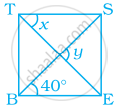
In the figure, BEST is a rhombus, Then the value of y – x is ______.
If a diagonal of a quadrilateral bisects both the angles, then it is a ______.
If all sides of a quadrilateral are equal, it is a ______.
