Advertisements
Advertisements
Question
Two adjacent angles of a parallelogram are as 1 : 2. Find the measures of all the angles of the parallelogram.
Advertisements
Solution
\[\text{ Let the angle be A and B }. \]
\[\text{ The angles are in the ratio of 1: 2 } . \]
\[\text{ Measures of } \angle A \text{ and } \angle B \text{ are } x° \text{ and } 2x° . \]
\[Then, \angle C = \angle A and \angle D = \angle B (\text{ opposite angles of a parallelogram are congruent })\]
\[\text{ As we know that the sum of adjacent angles of a parallelogram is } 180°. \]
\[ \therefore \angle A + \angle B = 180°\]
\[ \Rightarrow x° + 2x°= 180°\]
\[ \Rightarrow 3x° = 180°\]
\[ \Rightarrow x°= \frac{180°}{3} = 60°\]
\[\text{ Thus, measure of } \angle A = 60°, \angle B = 120°, \angle C = 60° \text{ and } \angle D = 120° .\]
RELATED QUESTIONS
In the following figure GUNS and RUNS are parallelogram. Find x and y.
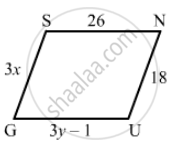
If an angle of a parallelogram is two-third of its adjacent angle, find the angles of the parallelogram.
All the angles of a quadrilateral are equal to each other. Find the measure of each. Is the quadrilateral a parallelogram? What special type of parallelogram is it?
Which of the following statement is true for a rhombus?
It has only two pairs of equal sides.
Which of the following statement is true for a rhombus?
Its diagonals are equal and perpendicular.
Fill in the blank, in the following, so as to make the statement true:
The diagonals of a rhombus ...... each other at ...... angles.
Fill in the blank, in each of the following, so as to make the statement true:
If the diagonals of a parallelogram bisect each other at right angles, then it is a ......
Which of the following statement is true for a rectangle?
Its diagonals are equal and bisect each other.
If opposite angles of a rhombus are (2x)° and (3x - 40)° then value of x is ______.
Lengths of diagonals of a rhombus ABCD are 16 cm and 12 cm. Find the side and perimeter of the rhombus.
