Advertisements
Advertisements
Question
The lengths of the diagonals of a Rhombus are 12 cm and 16 cm. Find the side of the rhombus
Advertisements
Solution
Since the diagonals of a rhombus bisect each other at right angles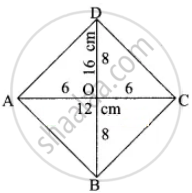
AO = `1/2` AC = `1/2 xx 12` = 6 cm
BO = `1/2` BD = `1/2 xx 16` = 8 cm
In the right triangle AOD
AD2 = AO2 + DO2
= 62 + 82
= 36 + 64
= 100
∴ AD = `sqrt(100)`
= 10
∴ AB = BC = CD = AD = 10 cm.
APPEARS IN
RELATED QUESTIONS
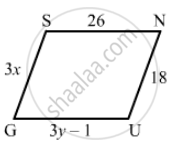
In the following figure GUNS and RUNS are parallelogram. Find x and y.
Which of the following statement is true for a rhombus?
It has two pairs of parallel sides.
Which of the following statement is true for a rhombus?
It has only two pairs of equal sides.
Which of the following statement is true for a rhombus?
It can be a square.
The diagonals of a quadrilateral are perpendicular to each other. Is such a quadrilateral always a rhombus? If your answer is 'No', draw a figure to justify your answer.
ABCD is a rhombus. If ∠ACB = 40°, find ∠ADB.
ABCD is a rhombus. If ∠BCA = 35°. find ∠ADC.
If a diagonal of a quadrilateral bisects both the angles, then it is a ______.
A rhombus is a parallelogram in which ______ sides are equal.
Construct a rhombus CLUE in which CL = 7.5 cm and LE = 6 cm.
